Visit my main blog at Monkey Wrench Revival.

Sunday, January 16, 2011

Winter Field Birds in Central Pennsylvania


Lapland Longspur
Image Credit: Nick Kontonicolas

Although it lacks the diversity of the spring and fall migrations, birding in the winter can be quite rewarding. One aspect of winter birding that I particularly enjoy is looking for birds in the open field – something I don’t typically focus on during the rest of the year.

Winter birding can also test your patience and your will. For one thing, it can get quite cold, and in the open field it can be a tad on the windy side. Moreover, the birds are not always cooperative. Case in point – a Northern Shrike (or two) has been seen lurking around Bald Eagle State Park since last December. Following the initial reports, I drove out to the park to get a glimpse at it. And that is exactly what I got – a glimpse! I spotted the bird perched on the top of a tree. I saw it just long enough to say it was a shrike when it dropped down into the brush. I was unable to relocate it.


Northern Shrike
Image Credit: Terry Sohl

I spent the better part of the next three weekends trudging through the snow in sub-zero temperatures trying to get a better look at the bird but came up empty each time. Upon reading the State College Bird Club listserv, I would see other birders reports of having seen the shrike. Many even posted photos on their bird blogs. I would go out again the next day and strike out. Finally, this past weekend I was able to relocate the bird along the West Launch Road. This guy sure made me earn my view. Perhaps in recognition of my efforts, it was very cooperative this time around. Although the bird moved frequently between perches, it stayed at each perch for several minutes and I was able to put the spotting scope on it for some nice views!

Other birds have not rewarded my patience. A pair of Short-eared Owls was recently reported in Huntingdon County on a neglected farm. The habitat is perfect for the owls. I drove out there last week to try and find them. About an hour before sunset, there were several Northern Harriers patrolling the fields. At least one of the harriers was an adult male, two others were juveniles, and the fourth was either a female or another juvie. Three Rough-legged Hawks and a male American Kestrel have also made their appearance. I waited around ‘til well after sunset, but the owl never showed up.

I went back a few days later and ran into another birder on the same quest. Again, the harriers, rough-legs and kestrel showed up, but not the owl. We returned again the next night with the same results. Because the Short-eared Owls are crepuscular, I figured I might have a chance to catch it just at dawn, so I went back the following morning. Again, no owl!


Horned Lark
Image Credit: Ohio Nature

Having struck out on the owls, I though I would test my luck with some open country birds. I drove the back roads through Center Hall, between Rts. 322 & 45. There were several moderate sized flocks of Horned Larks working their way around the fields. Yesterday, I tallied around 130 or so birds. I tried putting the spotting scope on the birds, but between my shivering in the sub-zero temps, and the wind rattling my scope, I was unable to get a clean look at the birds. Fortunately, a small group of about 15 birds alighted on the road about 50 yards off, providing me with a fairly good look.


Horned Lark, juvenile
Image Credit: GoBirding.eu

I went back again this afternoon. The wind was not nearly as bad, and the sun was breaking through the clouds periodically, providing good lighting conditions. I spotted a flock of about 100 Horned Larks in the same field as the previous day, but much closer to the road. I pulled over and set up the spotting scope. I got some excellent views of the birds feeding. I even spotted a few juvenile birds in the mix. The juveniles look similar to the adults, except that they lack the horn-like tufts, mustache and yellow throat.

I started scanning the flock for other field birds, particularly American Pipits, Snow Buntings and Lapland Longspurs. I missed on the pipits and bunting, but surprisingly, I did spot a Lapland Longspur – a rare but regular visitor to Central PA. This was a lifer for me - #505! I watched the longspur for several minutes before it got chased by an aggressive lark. The bird did not appear to fly off. Rather, it scampered into a cluster of wind-burned cornhusks, and I was unable to relocate it.


Merlin
Image Credit: eNature.com

I continued to search for the longspur, as well as look for the other above-mentioned birds when the flock suddenly shot up off the ground and scattered. I looked up to follow the birds when I spotted a male Merlin streaking overhead. The larks were a step ahead of the Merlin which did not even pursue them. Rather, it touched down at the top of a tree about 100 yards off. I spotted a second Merlin a few miles down the road, near the Elks Club Golf Course.

I still have a few more winter birds that I would like to pick-up over the next month or so. Crossbills and Redpolls have both been reported in the area, so I will come up with a strategy to search them out. I am also going to keep on target with the Short-eared Owl. Other birders who have seen it at the present location say the likelihood of seeing it on a given trip is about 50/50. I am batting 0 for 4 at present, so my chances for upcoming trips should be better. Moreover, a full moon is on slate for this week, so that should increase my chances of seeing it as well. Either way, I’ll keep going back until I get it.

Sunday, January 9, 2011

Winter Birding in Juniata County


Barn Owl
Image Credit: BBC – Inside Out

After striking out on both Northern Shrikes and the multiple flocks of Horned Larks roaming around the Centre County, PA, I figured a change of scenery might bring some good birding my way. Fortunately, I got a call from Chad Kauffman to see if I was interested in having a look around Juniata County.

I got the OK from the boss (read: wife), so I headed east on Rt. 322 early this morning to meet up with Chad in Mifflintown. We primarily birded the back roads and farms between Routes 35 & 333, from Oakland Mills to Port Royal.

Made several stops along the Juniata River looking for waterfowl. Overall, waterfowl were scarce, other than a few local Mallards and several flocks of migrating Canada Geese. We did spot a Bufflehead and three Common Mergansers on the Juniata, as well as some American Black Ducks and a lone Greater Scaup on a mostly frozen-over farm pond. A Bald Eagle was also observed circling above the river.


Northern Harrier
Image Credit: Lilibirds

The most productive areas were the back roads and farms. Our target raptor for the day was a Rough-legged Hawk. Unfortunately, we were unable to find one. Other raptors were plentiful. Red-tails Hawks and Kestrels were fairly abundant. Seems that there was one or two of each on just about every road we were on. Also had several Northern Harriers, including one individual that stayed out in front of our vehicle for a good stretch, almost as if he was leading us somewhere. The harrier had a light russet color on the breast and tail, suggesting that it was an immature bird.

We also stumbled upon a pair of Barn Owls sitting at the opening of an old barn silo that looks like it had seen better days. This was a particularly exiting, as the Barn Owls were lifers for me - #504!


Horned Larks
Image Credit: Dave Appleton

A few of the farms had recently spread manure. This drew in some good sized flocks of Horned Larks. We carefully scanned the flocks to see what else they might contain. We were unable to find any Lapland Longspurs, but Chad did spot a Snow Bunting.

A few of the farms also had some springs or seeps that seemed to draw a lot of sparrows. We scanned the seeps looking for shorebirds. The first few places we checked were not productive, except for a few Killdeer. Chad said he knew a reliable place where we might be able to pick up a Wilson’s Snipe or two. He was right about that! Just driving slowly along the road, we were able to count 16 Wilson’s Snipe – by far the most I have seen at one sitting. There was also a solitary American Pipit.


Wilson’s Snipe
Image Credit: Toronto Hiking

Near the end of the day, we had a fair number of Black Vultures and one Turkey Vulture. We finished up the day in a small park near the Lost Creek Shoe Shop where Chad spotted a Red-headed Woodpecker chiseling at a tree that looks like it has seen its fair share of woodpeckers.

In all, we tallied 44 species for the day.

Sunday, January 2, 2011

Birding on the Edge (of Centre Co)


Rough-legged Hawk, dark morph
Image Credit: Marcel Gauthier

I stopped by the Duck Pond this morning to get another look at the female Redhead (or is it a late-molting male) - as if I haven't seen it enough already. While I was there, I bumped into another birder (Steve lastname?) and we got to chating – about birds, of course. I mentioned that there was a Rough-legged Hawk sighting last week, along Rt. 220 near Bellefonte, in case he was interested in searching for it. He told me that there was a better and more reliable place to see them – out on the eastern edge of Centre County, near the Union County Line. More specifically, in the town of Woodward.

Woodward lies at the eastern end of Penns Valley, along Rt. 45 East. It’s mostly Amish farms out that way. According to Steve the birder, the Amish maintain hedgerows between fields, don’t plow the soil as often and refrain from the heavy use of pesticides. Taken together, this makes for a nice healthy population of rodents – primarily meadow voles. Sounds like good eatin’ for a raptor.

I asked for directions, and he kindly provided them. After lunch, I went out and spent the afternoon driving around Woodward Gap (map) tallying raptors. I made few loops around Cemetary and Jackson Hill Roads. I saw lots of raptors and other nice birds.

I spotted lots of American Kestrels along the power lines adjacent to Rt.45 (Penns Valley Rd.). I turned left at the second entrance to Cemetary Rd., and immediately picked up a Red-tailed Hawk. About a half-mile in, I spotted another hawk in a tree about 20 yards off the road (see "A" marker on map). It was a dark-morph Rough-legged Hawk. I observed it for about 1 minute or so before it took off and slowly glided across the field and set down in another tree about two-tenths of a mile off. I got a fantastic view! Might be the best look I have had of a Rough-leg.

I continued along Cemetary, spotted one Red-tailed Hawk after another. Also picked up a Sharp-shinned Hawk and a few Ravens. A lone Killdeer was observed hanging around a cattle feed station. Along the way, I spotted a handful of Goldfinches and American Tree Sparrows in an abandoned brush field.

It was getting late, so I started to make my way back to Rt. 45. I decided to sneak out the back way – along Pine Creek Hollow Rd. At the junction of Pine Creek and Jackson Hollow Roads, I spotted another Red-tail. While viewing it in my binoculars, I picked up another more distant bird to the northwest of Buffalo Mountain. To my surprise, it was a circling Black Vulture – somewhat of a rarity in Centre County at this time of year. Certainly the earliest I have ever seen one.


Black Vulture
Image Credit: Patrick Lynch

Woodward Gap looks like a promising place to pick up some good winter birds. I will definitely head back in February to search for more Rough-legs. I should also be able to find some Horned Larks, Snow Bunting, and perhaps even a Longspur. I'll keep you posted!

Saturday, January 1, 2011

Time to Start a New List!


Northern Goshawk, juvenile
Image Credit: Nature Pics

2010 is history! Time to start a new bird list for 2011!

My goal this year is to find 220 species within the state (PA), and 200 within the limits of Centre County. Both goals are modest and achievable. The county mark is a bit tougher, but I should be able to hit it if I pick a few rarities during the spring and fall migrations. In addition, I gotta make sure I pick up the easy birds I missed this past year (Herring Gull, Red-breasted Merganser, Screech Owl, Black-billed Cuckoo, Northern Waterthush, etc).

I got 365 days to get it done! Figured that New Year's Day was good a day as any to get started.

First bird of the year was an American Crow. I have a few that roost in the spruce trees in my yard. Having them around makes my alarm clock optional.

I hit the Centre Furnace Duck Pond at first light and picked up a few gimmes, like the Mallard, American Black Duck and Canada Goose. Also got a few regulars like the Kingfisher, Ring-necked Duck, Northern Shoveler and Redhead.

Next it was off to Millbrook Marsh where I added the House Sparrows that nest under the barn eaves, the Carolina Wrens taking up residence around the bird blind, and a few Song Sparrow I spotted along the boardwalk.

I spent the rest of the morning at Toftrees Gamelands (eastern part of SGL 176). Activity was quite high there this morning. Got all the common woodpeckers (Downy, Hairy, Sapsucker, Flicker, Red-belly & Pileated). Also got some finches (Gold, House and Purple), sparrows (White-throats, Juncos, Tree) and thrushes (Bluebird, Hermit).

After lunch I went out to Bald Eagle State Park. Picked up some Rock Pigeons, Mourning Doves, Kestrels, Red-tailed Hawks and a Cooper’s Hawk along route 220 on the drive out. Once I arrived at the park, I spent about 4 hours walking around in the intermittent drizzle looking for the Northern Shrike that is lurking there, but came up empty. But all was not lost. I picked up a juvenile Northern Goshawk late in the afternoon as I was getting ready to leave.

The Goshawk was a lifer for me - #503! It was perched in a small tree adjacent to the road (between the Frog Pond and the Inn). I pulled the car over and got some really good looks from a distance of about 30 yards. Awesome bird. Big hawk. Confirmed the ID by the size, uneven tail bands and the distinct white supercilium.

Ended the day with 39 species. What a great way to start the year!

Friday, December 31, 2010

2010: A Birding Year in Review


Harlequin Ducks
Image Credit: Paul Higgins

As 2010 draws to a close, I sit here in my man cave, banjo at my side, nursing a cold. I was initially planning on hitting the hot spots around town to take in some birds and to make a last gasp attempt to add a few species to my state and county year lists. Instead, I am popping Actifed, wiping snot off my beak, and sipping Earl Grey Tea (the best thing the British ever did!).

Not one to sulk (much), I decided that it would be a good time to review my bird sightings for the year. After birding, thinking about birding is the next best thing! So I pulled up my iTunes play list, hit shuffle, and started sifting though my field notes & eBird records. Turns out I had quite an interesting year!


Florida


Common Ground Dove
Image Credit: Phil Jeffrey

I started the year in Florida (trip report) – on Sanibel Island. I had already spent the previous day (Dec 31st) at Ding Darling NWR, where I picked up a few lifers. Early on New Years Day, I hit the beach at first light to hunt for seashells with the kids. Naturally, I bought along my binoculars and spotting scope. Got my first bird of the year – a Common Ground-Dove - in a small patch of dune grass between the beach and the Island Inn. Lots of birds on the beach as well: Sandwich Terns, Sanderlings, Snowy Plovers, White Ibises, etc. The rest of the island was fantastic for birds. Spent a few hours at Ding Darling NWR before hitting the road to Venus...Venus, Florida.

The main purpose of the journey to Venus was to visit Jacque Fresco and Roxanne Meadows of the Venus Project - the activist arm of the Zeitgeist Movement. Following the visit, I managed to do a little birding around the area. The highlights were a Yellow-throated Warbler (a Florida first for me), lots of Sandhill Cranes and a scattering of owl pellets.


Brown-headed Nuthatch
Image Credit: Errol Taskin

Then it was back to Kissimmee, the home of fiddling legend Vassar Clements. We stayed in central Florida for a few days. I spent most of the time birding around the numerous lakes in the region, seeing many of the expected water birds: Little Blue Herons, Cattle Egrets, Wood Storks, etc. I also made a diversion to the Disney Wilderness Preserve. The preserve was set aside by Disney as part of a mitigation effort to restore some of the wetlands Disney filled-in to build their sprawling monument to consumerism. The habitat at the preserve is a mix of wetlands, flatwoods, and scrub. My target species were Loggerhead Shrike, Bachman’s Sparrow and the Brown-headed Nuthatch, all of which are year-round residents. The shrike was easy, as they are abundant in the preserve. Unfortunately, I was unbable to locate the sparrow, but I did see a mixed flock of birds that included the Nuthatch, as well as Yellow-rumped and Pine Warblers.

Spring Migration in Pennsylvania

Although I continued to casually bird throughout the winter months, I spent most of my time on other pursuits. With the exception of Golden Eagles at the Tussey Mountain Hawkwatch, I did not see much worthy of note. Once spring was in the air, I was back out on a more regular basis.


Red-necked Phalarope
Image Credit: Jeremy Early

For me, the highlights of spring are the migrating shorebirds and the return of the wood warblers. This year was particularly exiting, in that I picked up a few lifers in unexpected places. Most notable are two species of phalaropes, the Wilson’s Phalarope and Red-necked Phalarope , which were initially reported by Matt O’Donnell and Drew Weber, respectively, at the Julian Wetlands.

I also attended my first PSO Meeting at Presque Isle on Lake Erie. I spent the weekend birding with many of the state’s most-experienced birders. I certainly learned quite a bit. And I picked-up two more lifers on the trip, a Mouring Warbler and a Prothonotary Warbler.


Summer Birding in Asia


Crested Goshawk
Photo credit: Birding2Asia

Once the kids were out of school, we loaded up the gear and headed across the pond to Taiwan(trip report). In Taiwan, I did most of my birding in two locations in Daliao, Kaohsiung County – the Zhong Zheng rice paddies (photo essay) and the campus of the Taiwan Military Academy. The highlights were the Emerald Dove and Crested Goshawk at the Military Academy, and the Ruddy-breasted Crake and Common Kingfisher at the rice paddies.

We then headed across the strait to mainland China to attend the World Expo in Shanghai and visit family in central China. Again, I bought the binoculars along (trip report). Shanghai was devoid of both birds and culture. It’s like Manhattan without Central Park and Times Square. With the exception of a flying turd – aka Eurasian Blackbird – Shanghai was a forgettable place. The Blackbird was only memorable because it was a lifer for me. Otherwise, it’s a downright ugly bird.


Blue Magpie
Image Credit: Birds of Shanghai

Xi Hu (West Lake) is about an hour or so by train from Shanghai. It’s a popular vacation spot for the locals. Despite the crowds and the urbanization, there were a surprisingly attractive mix of birds to be seen in the area, including Red-billed Starlings and Blue Magpies.

We then headed west to Guilin, in Guanxi Province. The scenery there is breathtaking! The karst mountains are legendary, and have been influential to countless Chinese poets and artists. Birding there was one of the best experiences of the year. The highights were a Dollarbird & Collared Crows along the Li Jiang.


Chinse Pond Heron
Image Credit: Penang Birder

Our next destination was Huangmei, in Hubei Province, for a family reunion. The area where we stayed was pretty rural – dominated by cotton, soy and various vegetable crops. Although I didn’t have much time to bird, I did manage to sneak away and roam the countryside for a few hours with my binos and a copy of Mark Brazil’s Birds of East Asia (read my book review here). The highlights were Whiskered Terns, Chinese Pond Herons, Long-tailed Shrikes and Yellow-billed Grosbeaks.

Over the course of my stay, I observed 121 species, 25 of which were lifers for me.

Back Home Again

Like John Denver sang, Hey it’s good to be back home again. Although I enjoyed the time in Asia, I was looking forward to getting back state side. Eating food from restaurants and street vendors, sleeping in a different bed everynight, and getting the Chinese version of Montezuma’s Revenge is enough to make anyone long for home. And besides, it was getting close to the start of fall migration. Next to spring migration, fall migration is the best time for birding.

This fall was very productive for birding. It seemed there were a lot more birders out and about finding (and reporting!) lots of interesting birds. Shorebirds were particularly good this year. The highlights were some Baird’s Sandpipers out at Bald Eagle SP (reported by Greg Grove) and Colyer Lake. Colyer also yielded a few Pectoral Sandpipers, as well as Least and Semi-palmated Sandpipers. A few weeks later, a Sanderling turned up on the beach at Bald Eagle.


Sanderling
Image Credit: Arthur Morris

Warblers were also plentiful, with unusually large numbers of several species. The highlight for me was my big fall-out day (report) at Scotia Barrens which occurred, oddly enough, on my birthday. I had over 200 ticks for 18 warbler species in just a few hours.

Perhaps the most interesting sighting I had was a hummingbird that came to my feeders for a few days. In late August, I had an unusual hummingbird with a bright orange gorget, rather than the ruby-red gorget one would expect for the local Ruby-throated Hummer. The hummer also had some rufous spots on its lower back, just above the tail. Turns out that it was one of the Selasphorus hummingbirds (Rufous or Allen’s), but I was unable to pin it down to the species level.

Little Big Year – sort of

Somewhere between the end of summer and the beginning of fall, I realized that I was in striking distance of getting 200 species within the state, and possibly within the limits of Centre County. While not a monumental feat, it would represent a personal milestone for me. Although I don’t consider myself an avid lister or twitcher, I must admit I was a bit enamored with the idea of trying to put together a list for myself. This is undoubtedly the influence from several of the many bird-themed books I read over the past year, such as Kingbird Highway and The Big Year. Anyway, I figured I give it a shot.


Snow Bunting
Image Credit: Tim Zurowski

In order to reach the modest goal, I was gonna have to get lucky. Since I had been away in the summer, I missed a few “easy” birds like the Black-billed Cuckoo. I made a list of the birds I needed and began to search them out, one by one. Thanks to the help of other birders reporting their observations, and some of my own right-place at the right-time luck, I was able to knock quite a few birds off my list, such as Eared Grebe, Black Scoter, White-wing Scoter, Dunlin, Snow Bunting, Rough-legged Hawk, and Harlequin Duck.

I hit the 200 mark for the state on November 1st, thanks to Drew Weber’s report of Black Scoters at Bald Eagle. I finished the year with 214 state birds. The Centre County list was a bit tougher. I entered December needing 9 birds to hit the 200 mark. While I gave it the old college try, I ended up the year a few short of the target. I finished with 196 birds for Centre County.

2010 Summary

Overall, I observed 315 species worldwide, including 36 lifers. That brings my world life list up to 502 species – 340 US birds and 162 birds outside the US.

Saturday, December 18, 2010

Zhong Zheng Road Rice Paddies - Summer 2010

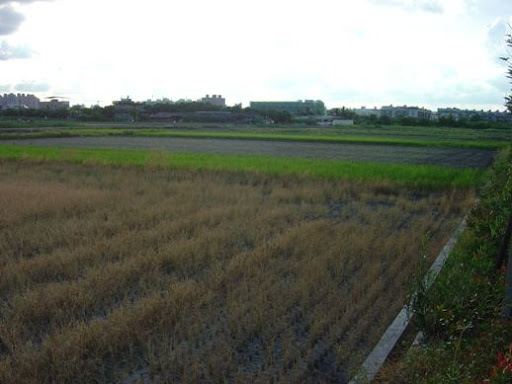
I spent part of the summer this year (2010) in Taiwan visiting my in-laws. While there, I did a fair amount of birding as I reported in a previous post. I spent a few hours each day birding along the rice paddies scattered around my in-laws home. I spent the majority of the time at the rice paddies off Zhong Zheng Rd (中正路), just southwest of the Daliao MRT station (map).


Looking north, toward Feng Dong Road

Looking south, toward Zhong Zheng Road

I took a handful of photos by holding my point-and-shoot (Sony DSC-P10) up to the eyepiece of my spotting scope (Pentax PF-80ED). Surprisingly, many of the photos turned out pretty well. I finally got a chance to sort through most of the photos and crop them. I posted some of them below.

One of the fields at the end of the paddies was completely flooded. There was a small stand of trees and shrubs lining the “pond” which served as a rookery for a number of herons and egrets.


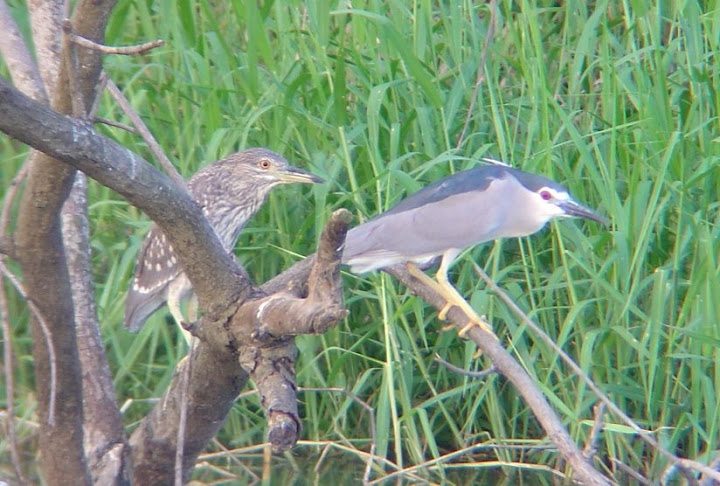
Black-crowned Night Herons

Black-crowned Night Herons were fairly abundant. The best time to see them is just before dusk. On a previous trip, I counted 177 individuals at the Old Railroad Bridge Park in Fongshan.


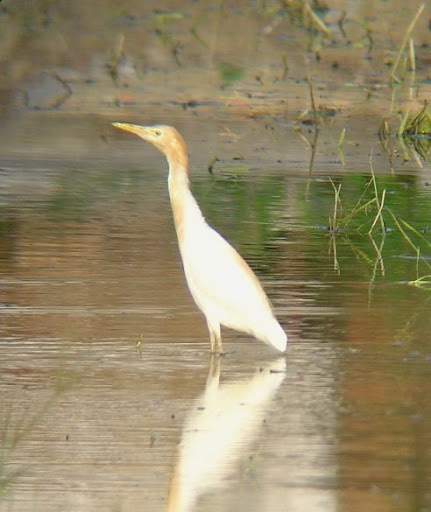
Cattle Egret

Cattle Egret were also abundant. Most were observed in the drained fields adjacent to the paddies. On one occasion, a farmer was plowing a drained field in preparation for sowing. I watched a small flock of about 15-20 Cattle Egret following the tractor, snatching up various grubs and small rodents unearthed by the plow.


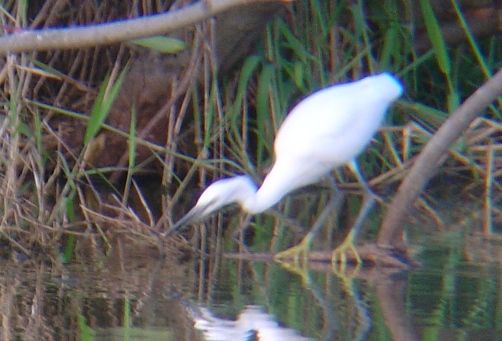
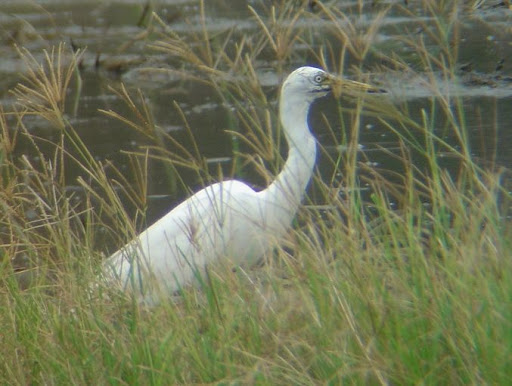
Little Egret

Another abundant wader! At first glance, these guys look like our Snowy Egrets, except that the Little Egret has darker lores and longer head plumes.


Intermediate Egret

Intermediate Egrets are mainly overwintering birds, although some resident birds have been observed (rarely). I did not see these birds when I first got to Taiwan in June. They started to show up early in August, around the same time as the early migrating shorebirds.


Rice is planted three times a year in Taiwan. When I first arrived in Taiwan, there were in the midst of harvesting the most recent crop. For a few weeks following harvest, the paddies were more like mudflats or shallow pools following a rain storm. This was a prime habitat for a variety of rails and waders.


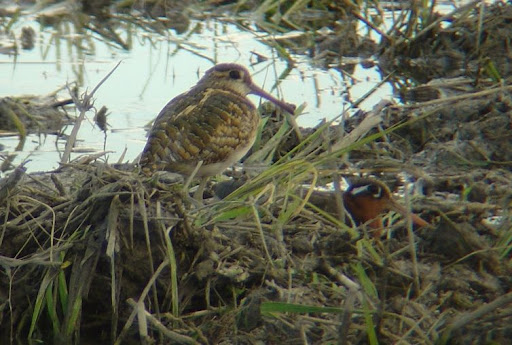
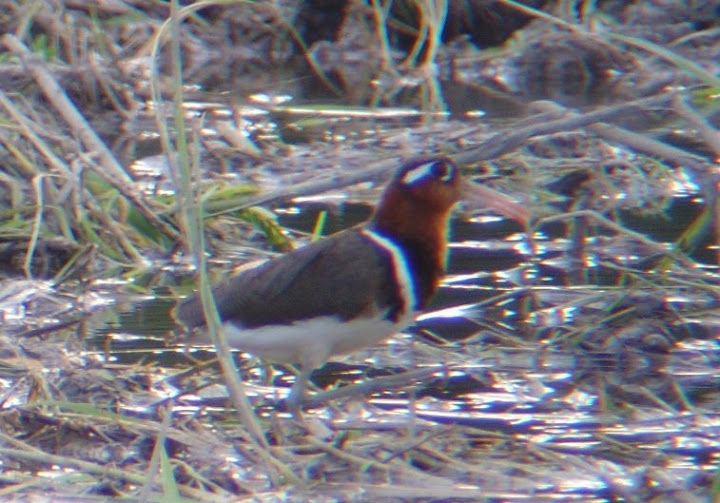
Greater Painted Snipe - pair

The Greater Painted Snipe inhabit heavily vegetated wet fields and grassy marshes. Despite their name, they are not true snipe. Actually, they are more closely related to jacanas. Like jacanas (and phalarope), Painted-Snipe are polyandrous and exhibit sex role reversal. Females fight each other for territory and court males. The nest is built by the male, generally on marshy ground. After laying a clutch, the female leaves the male to incubate the eggs and rear the young. She seeks another mate.


Greater Painted Snipe (female)


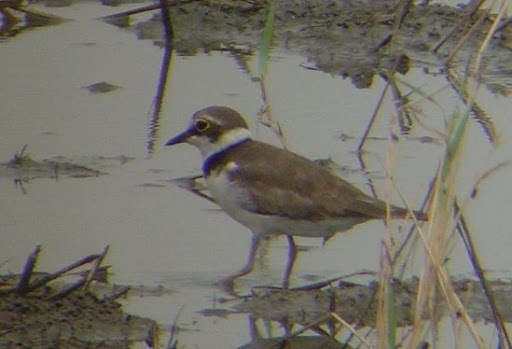
Little Ringed Plover

Taiwan's smallest plover. The Little Ringed Plover is primarily an overwintering bird, but resident populations are present in the southern part of the island. The plover has a fairly interesting feeding habit. As they walk along a mudflat, they occasionally tap their feet on the ground, presumably to create a disturbance and stir their prey.


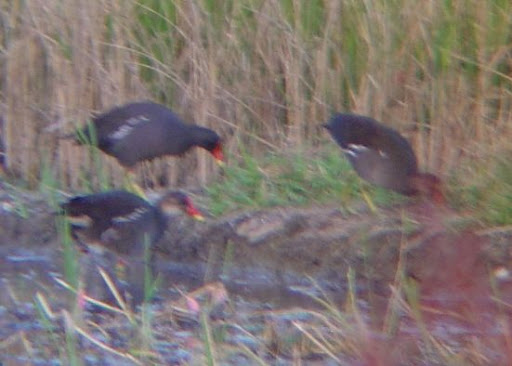
Common Moorhen

Local Taiwanese refer to moorhens as tsui gi (水鸡) - meaning "water chicken". I can not vouch for the taste. The moorhen are a common year-round resident, and are by far the most abundant rail on the island.


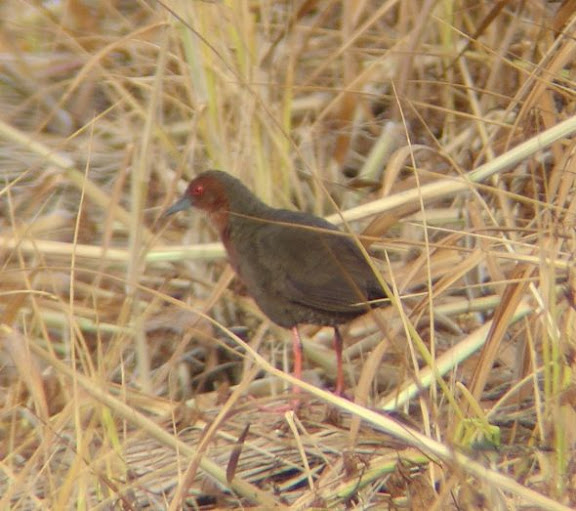
Ruddy-breasted Crake

Ruddy-breasted Crake are widely distributed on Taiwan; however, they can be difficult to see. They are very vigilant and wary. I was able to observe on only after playing a recording of its call and drawing it out onto the edge of a reed field. The moorhens in the area were very aggressive, driving the crake back into the reeds.


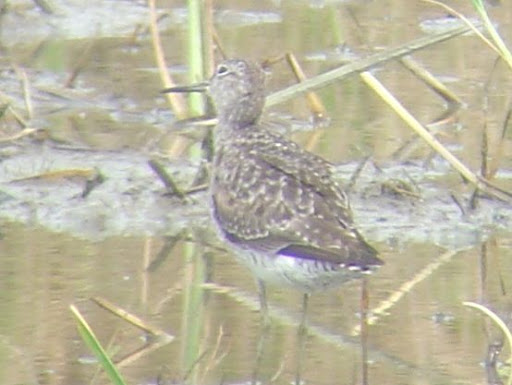
Wood Sandpiper

Common passage migrants in Taiwan. At first glance, they appear similar to our Yellow-legs. The Wood Sandpipers frequently bob their tails while feeding, in a manner reminiscent of a Common Sandpiper.


There were also a variety of swallows and martins flying around above the rice paddies. Some of the fields adjacent to the paddies were overgrown, attracting grassland birds.


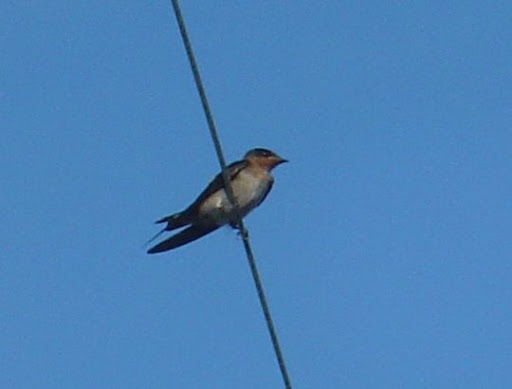
Pacific Swallow

The Pacific Swallow is broadly distributed throughout Taiwan. It is similar to our Barn Swallow (which is also present in Taiwan), except that he Pac Swallows lacks both a long forked tail and the black band on the lower throat.


Plain Martin

Plain Martins are common residents of the lowland plains, particularly near water. They nest primarily on riverbanks and eroded edges of fish pond.


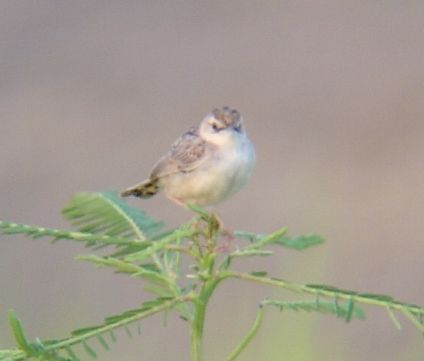
Zitting Cisticola

Cisticola were broadly distributed among lowland grassy plains, rice paddies and grassy scrubland. They are incessantly active. They have an interesting flight display where they fly around a territory in a high undulating flight path, chattering and singing as they go. Suddenly, they make a dive into the scrub. It was quite a spectacle.


Overall, I observed 32 species in and around the rice paddies. Unfortunately, there were some birds I was unable to photograph. Most notable were the Common Kingfisher and the Cinnamon Bittern. The Kingfishers were just too fast. My first sighting was somewhat serendipitous. I was walking the paddies in the late afternoon, during intermittent rain. Suddenly, two iridescent blue streaks shot down the grey water canal between the paddies. I jumped up on the retaining wall to see what just flew by. Couldn't see anything. A few minutes later, the birds flew back up the opposite way. One stopped and perched on the retaining wall on the other side of the canal. It only stayed for a few moments before flying off. The Cinnamon Bitterns were observed several times. Each time I saw one, it was a bird that flushed, flew about 50 yards or so, and then settled down inconspicuously in tall reeds.

Sunday, November 7, 2010

Eared Grebe at BESP


Eared Grebe at Bald Eagle State Park, Nov 6, 2010

The fall weather is finally here! The warblers are gone - mostly. The leaves are changing color and falling from the trees. Football season is at its midpoint. Cold weather is starting to settle in.

And that means ducks and gulls are on their way!

Reports are starting to trickle in from across the county and state. A gull here, a small rafts of ducks there. And with the regular migrants come others from out-of-town. Over the last week or so, a few interesting birds were showing up out at Bald Eagle State Park in Howard (Centre County, PA), so I grabbed my binoculars and put the spotting scope in the car and headed out to the park.

I arrived at the park around 9:00 am on a cold, rainy Saturday morning. I first hit Upper & Lower Greens Run, then headed down to the Rt. 150 overlook, and eventually made my way to the main area of the park. At Lower Greens Run, I spotted a small flock of Bufflehead and a lone Bonaparte's Gull patrolling Sayers Lake. The 150 overlook was quiet.

Upon entering the main area of the park, I headed straight down to the beach to scan for Snow Bunting. I came up empty on the buntings, but did manage to spot a Killdeer probing the sand. There was also a nice-sized flock of starlings and grackles in the trees adjacent to the beach. Most of the other areas of the park were not productive, so I headed out to the Bald Eagle viewing area to get a look at Sayers Dam. That is usually the most productive spot in the park.

I was particularly interesting in checking out the dam area, because Drew Weber spotted several White-winged Scoters there earlier in the morning. I spent about 30 minutes or so scanning the area with my spotting scope, but struck out on the scoters. I did mange to find several Common Mergansers, some Ruddy Ducks, a Common Loon and a flock of Canada Geese. There were several other ducks present, but the combination of the warm air on the surface of the lake and the cold air above caused a lot of refraction - like those wavy lines you see on the distant highway on warm days. Either way, I couldn't make out what the ducks were, so I bagged it and moved on.

Before leaving the park, I decided to search for any Northern Shrikes that may be present. This is about the time of year that one would expect a shrike to show up at the park. I checked several spots where the shrike has been observed in previous years but was unable to find one. But all was not lost. At the west boat launch, I did spot a small flock of American Coots - about 40 in all. I scanned the flock with my binos and picked out three odd birds. Two of them turned out to be female Ruddy Ducks. The other looked like a grebe.

At first glance, I was pretty sure that it was a Horned Grebe - a relatively common grebe for the east coast this time of year. In fact, several were seen at the park earlier in the week. Something about the bird did not sit right, so I went back to the car and grabbed my spotting scope. I got a pretty good look at the bird. To my surprise, it was an Eared Grebe - a western species not typically seen in the east. As the bird was in non-breeding plumage, I had to check for several key field marks to nail the ID: a slightly upturned bill, a peaked crown above the eye and a dusky neck.

To document the bird, I had to borrow my daughter's point-and-shoot digital camera and hold it up to the eye piece of my spotting scope. The resulting photos were of the "bigfoot quality", but sufficient for confirmation. This is the second Eared Grebe for me in Centre County - the first one was spotted in the Retention Pond back by lot 25 on the Penn State campus back in 2006.

Monday, September 13, 2010

Big Warbler Fall-out at Scotia Barrens


Blue-winged Warbler
Photo Credit: Arjuna Limitada

Autumn migration is in full swing. It is one of the best times of year to look for wood-warblers and other birds heading south for the winter. If you live in Centre County, Scotia Barrens (SGL 176) is among the best places to be.

Earlier this week, Woodcreeper was predicting a big migration event for Thursday and Friday. Recently, the weather conditions were not conducive for migrating birds. As a result, the birds were "piling-up", waiting for the right conditions to fly. Those condiditions were supposed to be right for a big flight on Wednesday and Thursday night. Unfortunately for me, I had to work. As such, I was unable to get out into the field to look for birds. As it turned out, most of the migrants ended up a bit the the east of central Pennsylvania.

I was hoping that the birds would continue in large numbers until at least the weekend. Excitedly, I headed out to Scotia Barrens early Saturday morning. It was a really slow day. Didn't see much at all. Sunday morning rolled around, and it was damp and drizzling. It didn't look very promising. I decided to go out anyway, as Monday would bring another work week.

As it turns out, it was a phenomenal day at Scotia! Easily the best day I have had in recent memory.


Whip-poor-will
Photo Credit: Mike Danzenbaker

I arrived at the research shed about 30 minutes before dawn. A few Whip-poor-wills and a Woodcock were active. I could also hear a migrating thrush overhead - mostly Swainson's Thrush. There were also others, but I didn't feel confident enough to ID them. I walked the paved road past the research shed just after sunrise. The trees around the field station were overloaded with warblers. There were easily a few hundred warblers present, as well as a nice sized flock of Waxwings. In addition, there were several Philadelphia Vireos as well.


Black-throated Green Warbler
Photo Credit: Lillian Stokes

After about 90 minutes, I returned to the main road. It started raining and the activity really slowed down. I ran into Greg Grove and we birded along the road, finding a Yellow-bellied Flycatcher. After the rain stopped, the birds picked up again. Wave after wave rolled thru. The area around the shed, as well as up and down the road about 100 yrds on each side had the most activity. Black-throated Green Warblers were seemingly everywhere. I stopped counting at 60 - there very easily could have been over 100 of that species alone. There were also large numbers of Blackburnian and Cape May Warblers.


Blackburnina Warbler
Photo Credit:

When I reluctantly left just before noon (to maintain marital bliss), the activity was still very high. In all, I observed 18 species of warbler. The full list follows:

Location: Scotia Barrens (IBA)
Observation date: 9/12/10
Number of species: 49

Ruffed Grouse 1
Turkey Vulture 1
Sharp-shinned Hawk 1
Red-tailed Hawk 1
American Woodcock 2
Great Horned Owl 1
Whip-poor-will 2
Red-bellied Woodpecker 1
Downy Woodpecker 1
Hairy Woodpecker 3
Northern Flicker 1
Pileated Woodpecker 2
Yellow-bellied Flycatcher 1
Least Flycatcher 1
Philadelphia Vireo 3
Red-eyed Vireo 8
Blue Jay 5
American Crow 7
Black-capped Chickadee 15
Tufted Titmouse 12
Red-breasted Nuthatch 1
White-breasted Nuthatch 4
Swainson's Thrush 20
American Robin 25
Gray Catbird 15
Cedar Waxwing 70
Blue-winged Warbler 3
Tennessee Warbler 4
Nashville Warbler 21
Northern Parula 4
Chestnut-sided Warbler 16
Magnolia Warbler 9
Cape May Warbler 25
Black-throated Blue Warbler 3
Black-throated Green Warbler 60
Blackburnian Warbler 22
Pine Warbler 11
Bay-breasted Warbler 3
Blackpoll Warbler 6
Black-and-white Warbler 6
American Redstart 7
Ovenbird 2
Common Yellowthroat 11
Hooded Warbler 3

Eastern Towhee 7
Scarlet Tanager 3
Northern Cardinal 1
Rose-breasted Grosbeak 2
American Goldfinch 1

This report was generated automatically by eBird v2(http://ebird.org)

Saturday, September 11, 2010

Early Fall Sandpipers at Colyer Lake


Baird's Sandpiper
Photo Credit: Brilliant Student

It's early fall, so sandpipers are on the move - heading south for the winter. While most people associate sandpipers with the beach or coastal mudflats, sandpipers and other waders do show up inland in pretty good numbers.

In southern Centre County, many lakes are below their spring water levels as the summer wanes. This exposes mudflats that are good feeding habitats for sandpipers. There are several spots in the vicinity of State College that are particularly good: Colyer Lake (just off of Rt. 322), Julian Wetlands (on Old Rt. 220), & Bald Eagle State Park (Howard, PA).


Pectoral Sandpiper
Photo Credit: The Bird Guide

This year, Colyer has been very productive. During one week in early September, I observed eight species of sandpiper and one plover. The full list follows.

The highlights were the Pectoral & Baird's Sandpipers. The Baird's Sandpiper was especially interesting. This bird nests up in arctic tundra and migrates through the Great Plains. It is pretty uncommon along either coast. Up until this year, I have never seen one. This year, I have seen it twice. The first one was reported by Greg Grove on the beach at Bald Eagle SP. The one I spotted at Colyer was the second one.

Sightings at Colyer Lake, September 2010

Killdeer
Spotted Sandpiper
Solitary Sandpiper
Greater Yellowlegs
Lesser Yellowlegs
Semipalmated Sandpiper
Least Sandpiper
Baird's Sandpiper
Pectoral Sandpiper

Tuesday, August 10, 2010

Azure-winged Magpie - #500 on Life List


Azure-winged Magpie, Cyanopica cyana
Image Credit: Gordon Langsbury

I was going over my bird list from my summer trip to China. It turns out that I surpassed 500 species for my life list. Species #500 was an Azure-winged Magpie.

The Azure-winged Magpie was observed on July 29, 2010, in the Li Shizhen Gardens in Hubei, China. My daughter Maria was ahead of me on the trail and stirred the bird. She spotted it and immeadiately called my attention to it. I got a good look at it as it flew past and disappered into a grove of evergreen trees. On the way out of the gardens about 15 minutes later, I spotted it again, perched in a tree where I got an really nice view.

I referenced Wikipedia to get a little background on the magpie.

The Azure-winged Magpie is a bird in the crow family. It is 31–35 cm long and similar in overall shape to the European Magpie (Pica pica) but is more slender with proportionately smaller legs and bill. It belongs to the monotypical genus Cyanopica.

It has a glossy black top to the head and a white throat. The underparts and the back are a light grey-fawn in colour with the wings and the feathers of the long (16–20 cm) tail are an azure blue. It inhabits various types of coniferous (mainly pine) and broadleaf forest, including parks and gardens in the eastern populations.

It occurs in two population groups separated by a huge geographical region between. One population lives in Western Europe, specifically the southwestern part of the Iberian Peninsula, in Spain and Portugal. The other population occurs over a much larger region of eastern Asia in most of China, Korea, Japan, and north into Mongolia. Recent genetic analysis has shown that the two populations are distinct at species level [1], under which the Iberian Azure-winged Magpie would take the name Cyanopica cooki, though this change has yet to be formally incorporated in the European bird list.

Often Azure-winged Magpies find food as a family group or several groups making flocks of up to 70 birds. The largest groups congregate after the breeding season and throughout the winter months. Their diet consists mainly of acorns (oak seeds) and pine nuts, extensively supplemented by invertebrates and their larvae, soft fruits and berries, and also human-provided scraps in parks and towns.

This species usually nests in loose, open colonies with a single nest in each tree. There are usually between 6–8 eggs that are incubated for 15 days.

The voice is a quick fired and metallic sounding kwink-kwink-kwink usually preceded by a single krarrah.

Thursday, August 5, 2010

China Trip Report - Summer 2010


Long-tailed Shrike (Lanius schach)
Image Credit:Mekshat

This summer (2010), I made two one-weeks visits to China. The first visit was to Shanghai at the end of June to attend the World Expo. The second visit was to Hubei at the beginning of August to attend a family reunion. Like my trip to Taiwan, which was sandwiched in between the China visits, I did not get the opportunity to bird extensively as I would have liked. That being said, I did manage to do a little birding in my spare time. In all, I observed 61 species, including 14 lifers (*).

I essentially used two field guides during the trip: Mark Brazil’s Birds of East Asia (my primary guide), and MacKinnon & Philip's Field Guide to the Birds of China. My reviews for both guides can be found here.


Xihu

When I was not at the World Expo, I did a bit of birding in the park adjacent to our hotel in Shanghai. I was very disappointed. Other than a few Eurasian Tree Sparrows and some Light-vented Bulbuls, Shanghai is almost devoid of birds (and culture). In order to see birds, we made a short field trip in the neighboring province of Zhejiang - to the city of Hangzhou.


Red-billed Starling (Sturnus sericeus).
Photo credit: Martin Hale, OBC

Hangzhou is located about an hour’s train ride southwest of Shanghai. The city is home of Xihu (West Lake), a major tourist draw. Incidentally, Xihu draws large numbers of Mandarin Ducks in the winter - something I long to see. I did most of my birding in the parks adjacent to Xihu and some natural areas within a few miles of the lake.

The highlights were the Red-billed Starling and the Blue Magpie. I observed both of them near the koi pond by Baochu Pagoda. The magpie was quite racous. I observed several take off from an unseen perch in a magnolia tree and glide across the pond. The are quite a spectacular sight with their red bills and long flowing tails. Later, one perched low in a tree just a few feet from where we were sitting and stayed for a few minutes before moving on. Just across the pond, there was a pair of Red-billed Starlings straifing each other - apparently battling it out for prime perch overlooking the pond.

There were also several Eurasian Blackbirds in the park. I must say that it is the most disappointing bird I have seen in quite some time. After hearing Paul McCartney sing his poetic verses about the Blackbird on the Beatles White Album, I guess I developed something of a special affection for the bird. Upon seeing the bird for the first time, I was completely let down. The Blackbird is a downright ugly bird! I immeadiately thought of a term I have heard birders throw around when they see drab Turdus thrushes. The term is "flying turd". I think whoever coined that term did so when he was looking at a Blackbird. On a positive note, the Blackbird is quite a splendid singer. I guess you can see that his combination of looks and voice make him the Lyle Lovett of the bird world.

Here are my observations:

Barn Swallow
Vinous-throated Parrotbill
Brown-rumped Minivet *
Crested Myna
Eurasian Blackbird *
Eurasian Tree Sparrow
Great Tit *
Indian Spot-billed Duck
Japanese White-eye
Little Egret
Light-vented Bulbul
Oriental Magpie-Robin
Mallard
Blue Magpie *
Red-billed Starling *
Red-rumped Swallow *
Rock Pigeon
Spotted Dove
Black-crowned Night-Heron


Guangxi & Hubei


Limestone Mountains, Guilin China
Photo credit: olloo

We then traveled down west for a family reunion. Before heading home, we made a detour and headed down to Guilin in Guangxi province. Guilin and the neighboring area of Yangshuo are famous for their mountainous landscapes. The mountains there have been inspirational to Chinese poets and artists for thousands of years. The scenery is so spectacular that birding almost becomes secondary.


Japanese White-eye (Zosterops japonicus)
Image Credit: mononofu

We took a river trip through the mountains in Yangshuo via a bamboo raft. The Lijiang is a relatively calm river making for a very peaceful trip. Common Kingfishers and Plumbeous Water Redstarts were abundant along the river banks. In some places, the mountains rise up vertically along the banks creating a canyon. We stopped at a spot where water was running down the canyon wall. I guess it was technically a waterfall, but the volume of water coming off seemed much to low to justify calling it one. Regardless of its classification, the “waterfall” attracted lots of birds. Blue Whistling-Thrushes and White-tailed Robins darted around the base of the waterfall snatching flies. Light-vented Bulbuls hawked insects from perches in the trees. I also heard the high thin twitterings of Japanese White-eye flying overhead (listen here). The White-eye travel in small flocks of 20 or so birds, similar to our Waxwings, and are fairly abundant throughout southern China. There were also two hawks soaring overhead which I was unable to identify.


Dollarbird (Eurystomus orientalis).
Photo credit: Michelle & Peter Wong

High up on the cliff, above the waterfall (about 100 ft up), my daughter spotted a bird sitting on a small branch. It turned out to be a Dollarbird sallying for insects. Further on down the river, there was a herd of water buffalo eating vegetation. We took a detour around them. In doing so, we stumbled into a small roosting place for Collared Crows. As our raft approached, the crows took off and flew across the river directly in front of us. The white collar gave the crw the apprearance of wearing a fur stole. I never thought a crow could look so noble.


Collared Crow (Corvus torquatus).
Photo credit: Jonathan Kwong, OBC

There were also small number of fisherman on the Lijiang. Rather than using rods or nets, the fisherman were using birds - specifically Great Cormorants - to catch fish. A restrictive band is typically tied around the birds neck. The band allows the cormorants to swallow small fish, but prevents them from swallowing large fish. Upon catching a fish, the cormorant has been trained to return to the fisherman's boat where he coughs up his catch. Its all in a day's work I suppose.


Here is a list of my observations:

Black-crowned Night-Heron
Blue Whistling-Thrush
Chinese Pond-Heron *
Collared Crow *
Common Kingfisher
Common Sandpiper
Dollarbird *
Yellow-bellied Prinia
Eurasian Tree Sparrow
Crested Myna
White-tailed Robin
Greater Coucal *
Light-vented Bulbul
Plumbeous Redstart
Oriental Magpie-Robin
Red Collared-Dove
Common Tailorbird *
Vinous-throated Parrotbill
White Wagtail
Japanese White-eye


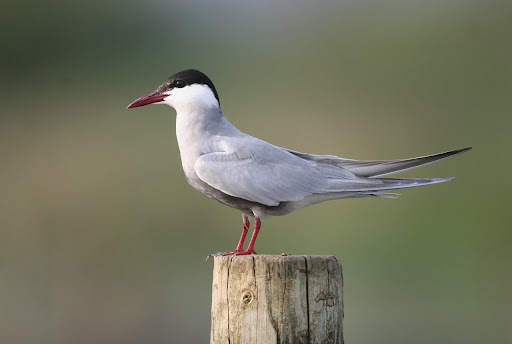
Whiskered Tern (Chlidonias hybrida).
Photo credit: Steve Hinton

We then traveled north to Huangmei in Hubei Province for a family reunion. My wife’s father left China when he was 16 to fight with Chiang Kai-shek. With the communist victory, Chiang’s troops fled to Taiwan. About 10 years ago, China and Taiwan restored relations and my father-in-law was able to return home for the first time in 50 years. Unfortunately his parents and all his siblings were gone. He did have quite a large number of cousins, nieces, nephews, etc. that still lived in the village. This trip was the first time my wife has gone to the village to see where her father grew up and to meet the rest of the family. It was a pretty moving experience to say the least.

The area where my wife’s family lives in Huangmei is pretty rural. Chickens running around the neighborhood (and through your house), livestock roaming the streets, swallows nesting in your living room, etc. The area is primarily rice paddies and cotton fields. There was also a sizeable lake behind the village that attracts lots of birds.


Chinese Pond-Heron (Ardeola bacchus).
Photo credit: Michelle & Peter Wong

In the mornings, I walked the area around the lake looking for birds. The pond was constantly patrolled by a small flock of Whiskered Terns. There were also a few Little Grebes diving for fish and several rails moving through the vegetation that I was unable to identify. Chinese Pond-Herons were ubiquitous. With there charcoal black backs, chestnut-colored heads and white tail and wings, they are quite striking birds to observe in flight. Long-tailed Shrikes were also pretty abundant in the fields adjacent to the lake. I had over 10 shrikes one morning. One began calling when I was about 30 yards away. He allowed me to approach to within 20 feet before he got uncomfortable and took off. Below is a shaky video clip of the encounter.


After the reunion, we packed up to head home. On the way to the Wuhan airport, we made a quick stop at the Li Shizhen Gardens. Li Shizhen, a distant relative of my wife, was a legendary physican and pharmacologist. He is considered by many to be the father of Chinese herbal medicine. In addition, he was perhaps the greatest naturalist in Chinese history. The Li Herbal Gardens are located about a ¼ mile from the Yangtze River and are surrounded by lots of wetlands. There were quite a few birds present in the gardens themselves, including several White Wagtails, Oriental Magpie-robins and Masked Laughingthrushes. The Laughingthrushes quicky took cover when they spotted me, but were very responsive to pishing.


Here are my observations:

Little Grebe
Little Egret
Chinese Pond-Heron
Whiskered Tern *
Common Kingfisher
Lesser Coucal
Eurasian Hoopoe
Long-tailed Shrike
Black Drongo
Pacific Swallow
Red-rumped Swallow
Light-vented Bulbul
Masked Laughingthrush
Oriental Magpie-Robin
Eurasian Blackbird
Crested Myna
Common Myna
White Wagtail
Yellow-billed Grosbeak *
Eurasian Tree Sparrow


Azure-winged Magpie (Cyanopica cyanus).
Photo credit: John Henry

The highlight of the whole trip was an Azure-winged Magpie that we saw at the Li Herbal Gardens. My daughter Maria was ahead of me on the trail and stirred the bird. She spotted it and immeadiately called my attention to it. I got a good look at it as it flew past and disappered into a grove of evergreen trees. On the way out of the gardens about 15 minutes later, I spotted it again, perched in a tree where I got an really nice view. Really a handsome bird. Even more monumental for me is the fact that it was the 500th bird on my life list.