Visit my main blog at Monkey Wrench Revival.

Thursday, August 5, 2010

China Trip Report - Summer 2010


Long-tailed Shrike (Lanius schach)
Image Credit:Mekshat

This summer (2010), I made two one-weeks visits to China. The first visit was to Shanghai at the end of June to attend the World Expo. The second visit was to Hubei at the beginning of August to attend a family reunion. Like my trip to Taiwan, which was sandwiched in between the China visits, I did not get the opportunity to bird extensively as I would have liked. That being said, I did manage to do a little birding in my spare time. In all, I observed 61 species, including 14 lifers (*).

I essentially used two field guides during the trip: Mark Brazil’s Birds of East Asia (my primary guide), and MacKinnon & Philip's Field Guide to the Birds of China. My reviews for both guides can be found here.


Xihu

When I was not at the World Expo, I did a bit of birding in the park adjacent to our hotel in Shanghai. I was very disappointed. Other than a few Eurasian Tree Sparrows and some Light-vented Bulbuls, Shanghai is almost devoid of birds (and culture). In order to see birds, we made a short field trip in the neighboring province of Zhejiang - to the city of Hangzhou.


Red-billed Starling (Sturnus sericeus).
Photo credit: Martin Hale, OBC

Hangzhou is located about an hour’s train ride southwest of Shanghai. The city is home of Xihu (West Lake), a major tourist draw. Incidentally, Xihu draws large numbers of Mandarin Ducks in the winter - something I long to see. I did most of my birding in the parks adjacent to Xihu and some natural areas within a few miles of the lake.

The highlights were the Red-billed Starling and the Blue Magpie. I observed both of them near the koi pond by Baochu Pagoda. The magpie was quite racous. I observed several take off from an unseen perch in a magnolia tree and glide across the pond. The are quite a spectacular sight with their red bills and long flowing tails. Later, one perched low in a tree just a few feet from where we were sitting and stayed for a few minutes before moving on. Just across the pond, there was a pair of Red-billed Starlings straifing each other - apparently battling it out for prime perch overlooking the pond.

There were also several Eurasian Blackbirds in the park. I must say that it is the most disappointing bird I have seen in quite some time. After hearing Paul McCartney sing his poetic verses about the Blackbird on the Beatles White Album, I guess I developed something of a special affection for the bird. Upon seeing the bird for the first time, I was completely let down. The Blackbird is a downright ugly bird! I immeadiately thought of a term I have heard birders throw around when they see drab Turdus thrushes. The term is "flying turd". I think whoever coined that term did so when he was looking at a Blackbird. On a positive note, the Blackbird is quite a splendid singer. I guess you can see that his combination of looks and voice make him the Lyle Lovett of the bird world.

Here are my observations:

Barn Swallow
Vinous-throated Parrotbill
Brown-rumped Minivet *
Crested Myna
Eurasian Blackbird *
Eurasian Tree Sparrow
Great Tit *
Indian Spot-billed Duck
Japanese White-eye
Little Egret
Light-vented Bulbul
Oriental Magpie-Robin
Mallard
Blue Magpie *
Red-billed Starling *
Red-rumped Swallow *
Rock Pigeon
Spotted Dove
Black-crowned Night-Heron


Guangxi & Hubei


Limestone Mountains, Guilin China
Photo credit: olloo

We then traveled down west for a family reunion. Before heading home, we made a detour and headed down to Guilin in Guangxi province. Guilin and the neighboring area of Yangshuo are famous for their mountainous landscapes. The mountains there have been inspirational to Chinese poets and artists for thousands of years. The scenery is so spectacular that birding almost becomes secondary.


Japanese White-eye (Zosterops japonicus)
Image Credit: mononofu

We took a river trip through the mountains in Yangshuo via a bamboo raft. The Lijiang is a relatively calm river making for a very peaceful trip. Common Kingfishers and Plumbeous Water Redstarts were abundant along the river banks. In some places, the mountains rise up vertically along the banks creating a canyon. We stopped at a spot where water was running down the canyon wall. I guess it was technically a waterfall, but the volume of water coming off seemed much to low to justify calling it one. Regardless of its classification, the “waterfall” attracted lots of birds. Blue Whistling-Thrushes and White-tailed Robins darted around the base of the waterfall snatching flies. Light-vented Bulbuls hawked insects from perches in the trees. I also heard the high thin twitterings of Japanese White-eye flying overhead (listen here). The White-eye travel in small flocks of 20 or so birds, similar to our Waxwings, and are fairly abundant throughout southern China. There were also two hawks soaring overhead which I was unable to identify.


Dollarbird (Eurystomus orientalis).
Photo credit: Michelle & Peter Wong

High up on the cliff, above the waterfall (about 100 ft up), my daughter spotted a bird sitting on a small branch. It turned out to be a Dollarbird sallying for insects. Further on down the river, there was a herd of water buffalo eating vegetation. We took a detour around them. In doing so, we stumbled into a small roosting place for Collared Crows. As our raft approached, the crows took off and flew across the river directly in front of us. The white collar gave the crw the apprearance of wearing a fur stole. I never thought a crow could look so noble.


Collared Crow (Corvus torquatus).
Photo credit: Jonathan Kwong, OBC

There were also small number of fisherman on the Lijiang. Rather than using rods or nets, the fisherman were using birds - specifically Great Cormorants - to catch fish. A restrictive band is typically tied around the birds neck. The band allows the cormorants to swallow small fish, but prevents them from swallowing large fish. Upon catching a fish, the cormorant has been trained to return to the fisherman's boat where he coughs up his catch. Its all in a day's work I suppose.


Here is a list of my observations:

Black-crowned Night-Heron
Blue Whistling-Thrush
Chinese Pond-Heron *
Collared Crow *
Common Kingfisher
Common Sandpiper
Dollarbird *
Yellow-bellied Prinia
Eurasian Tree Sparrow
Crested Myna
White-tailed Robin
Greater Coucal *
Light-vented Bulbul
Plumbeous Redstart
Oriental Magpie-Robin
Red Collared-Dove
Common Tailorbird *
Vinous-throated Parrotbill
White Wagtail
Japanese White-eye
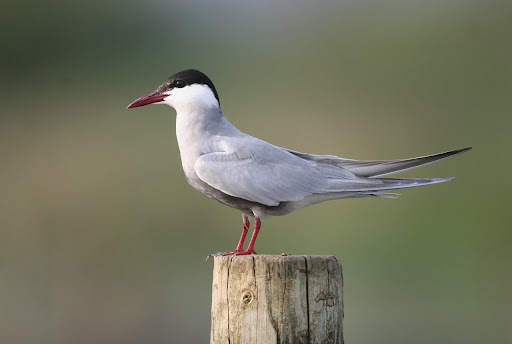

Whiskered Tern (Chlidonias hybrida).
Photo credit: Steve Hinton

We then traveled north to Huangmei in Hubei Province for a family reunion. My wife’s father left China when he was 16 to fight with Chiang Kai-shek. With the communist victory, Chiang’s troops fled to Taiwan. About 10 years ago, China and Taiwan restored relations and my father-in-law was able to return home for the first time in 50 years. Unfortunately his parents and all his siblings were gone. He did have quite a large number of cousins, nieces, nephews, etc. that still lived in the village. This trip was the first time my wife has gone to the village to see where her father grew up and to meet the rest of the family. It was a pretty moving experience to say the least.

The area where my wife’s family lives in Huangmei is pretty rural. Chickens running around the neighborhood (and through your house), livestock roaming the streets, swallows nesting in your living room, etc. The area is primarily rice paddies and cotton fields. There was also a sizeable lake behind the village that attracts lots of birds.


Chinese Pond-Heron (Ardeola bacchus).
Photo credit: Michelle & Peter Wong

In the mornings, I walked the area around the lake looking for birds. The pond was constantly patrolled by a small flock of Whiskered Terns. There were also a few Little Grebes diving for fish and several rails moving through the vegetation that I was unable to identify. Chinese Pond-Herons were ubiquitous. With there charcoal black backs, chestnut-colored heads and white tail and wings, they are quite striking birds to observe in flight. Long-tailed Shrikes were also pretty abundant in the fields adjacent to the lake. I had over 10 shrikes one morning. One began calling when I was about 30 yards away. He allowed me to approach to within 20 feet before he got uncomfortable and took off. Below is a shaky video clip of the encounter.


After the reunion, we packed up to head home. On the way to the Wuhan airport, we made a quick stop at the Li Shizhen Gardens. Li Shizhen, a distant relative of my wife, was a legendary physican and pharmacologist. He is considered by many to be the father of Chinese herbal medicine. In addition, he was perhaps the greatest naturalist in Chinese history. The Li Herbal Gardens are located about a ¼ mile from the Yangtze River and are surrounded by lots of wetlands. There were quite a few birds present in the gardens themselves, including several White Wagtails, Oriental Magpie-robins and Masked Laughingthrushes. The Laughingthrushes quicky took cover when they spotted me, but were very responsive to pishing.


Here are my observations:

Little Grebe
Little Egret
Chinese Pond-Heron
Whiskered Tern *
Common Kingfisher
Lesser Coucal
Eurasian Hoopoe
Long-tailed Shrike
Black Drongo
Pacific Swallow
Red-rumped Swallow
Light-vented Bulbul
Masked Laughingthrush
Oriental Magpie-Robin
Eurasian Blackbird
Crested Myna
Common Myna
White Wagtail
Yellow-billed Grosbeak *
Eurasian Tree Sparrow


Azure-winged Magpie (Cyanopica cyanus).
Photo credit: John Henry

The highlight of the whole trip was an Azure-winged Magpie that we saw at the Li Herbal Gardens. My daughter Maria was ahead of me on the trail and stirred the bird. She spotted it and immeadiately called my attention to it. I got a good look at it as it flew past and disappered into a grove of evergreen trees. On the way out of the gardens about 15 minutes later, I spotted it again, perched in a tree where I got an really nice view. Really a handsome bird. Even more monumental for me is the fact that it was the 500th bird on my life list.

Taiwan Trip Report - Summer 2010


Common Kingfisher (Alcedo atthis).
Photo credit: Cards Unlimited

This summer (2010), I spent about four weeks in Taiwan visiting in-laws. Although I did not get the opportunity to bird extensively as I would have liked, I did manage to sneak some time in.

I essentially used two field guides during the trip: Mark Brazil’s Birds of East Asia (which I previously reviewed), and Wu Sen-Hsiong's Field Guide to the Wild Birds of Taiwan. In addition to field guides, I also made use of publicly accessible field recordings from the Macauley Library.

I also picked up several excellent photographic guides while in Taiwan: Taiwan Birds (Owl Publishing), Photo Guide to the Wild Birds of Taiwan by Jason Chen, and A Photographic Guide to Birds of Taiwan (Taiwan Wild Bird Society).


Taiwan Birds (Owl Publishing)


Photo Guide to the Wild Birds of Taiwan by Jason Chen


A Photographic Guide to Birds of Taiwan (Taiwan Wild Bird Society)

The first two books are entirely in Chinese, except for Latin and common names; however, they both are worthwhile to have. The photos in the book by Owl Publishing are not the best, but the book has excellent range maps for Taiwan. Jason Chen’s book has the best photos among the three. The pictures are large and usually have several photos per bird. The book published by the Taiwan Wild Bird Society has good photos, but the photos are small and there is typically only one. The advantage of the book is that it is written in English and gives detailed descriptions of habitat, behavior and distribution.


Birding in Daliao


Emerald Dove (Chalcophaps indica).
Photo credit: Tamilnadu

I did most of my birding in Daliao (Kaohsiung County), as on previous trips. The campus of the Taiwan Military Academy is about a half mile from my in-laws home. Behind the campus is a wooded area used for training exercises. The locals also use it as a community garden and park. The habitat is mostly low hills that were largely overtaken by grasslands and bamboo thickets, with a few hardwood trees scattered about. It’s a haven for birds, as Daliao is a fairly well developed area. The grounds of the military academy are sort of like a forested island in the middle of a mixed urban and agricultural area.

Over the course of my stay, I observed 33 species on the campus, including three lifers (Crested Goshawk, Emerald Dove & Striated Swallow). I also observed a small flock of Indian Silverbill. I have seen them before in Dubai, but never in Taiwan. The Silverbill are not native to Taiwan. They have only recently become established there, probably due to escapes from the songbird trade which is fairly prominent in Taiwan.


Chinese Bamboo Partridge (Bambusicola thoracicus)
Image Credit: Stip Hushan Dam!

Another highlight was the Chinese Bamboo-Partridge. I have heard the Bamboo-Partridge there many times. The call is distincitive - no mistaking it for anything else (listen here). There is one particularly densely wooded hill adjacent to the rifle range that seems to be favored by the partridge. I used my iPod to call them in. Only had to play the call twice before they all came to investigate. I saw two running in the grass, but they quickly took cover and I didn't get a clean look. The third one popped up on a stump and started calling vociferously. He stayed a good 7 or 8 minutes before dropping down out of sight. It was all pretty exciting.


Here is a list of my observations:

Chinese Bamboo-Partridge
Great Egret
Cattle Egret
Crested Goshawk *
White-breasted Waterhen
Common Moorhen
Barred Buttonquail
Oriental Turtle-Dove
Red Collared-Dove
Spotted Dove
Emerald Dove *
Lesser Coucal
House Swift
Black-browed Barbet
Black Drongo
Black-naped Monarch
Gray Treepie
Barn Swallow
Pacific Swallow
Striated Swallow *
Collared Finchbill
Light-vented Bulbul
Golden-headed Cisticola
Yellow-bellied Prinia
Plain Prinia
Vinous-throated Parrotbill
Streak-breasted Scimitar-Babbler
Japanese White-eye
Common Myna
Eurasian Tree Sparrow
Indian Silverbill
White-rumped Munia
Nutmeg Mannikin


Rice Paddies


Ruddy-breasted Crake (Porzana fusca).
Photo credit: Robin Newlin, Birds Korea

There are also a number of small farms and rice paddies scattered through Daliao, as they are just about everywhere in Taiwan. The rice paddies are home to a variety of waders, rails, etc. In addition, Taiwanese farmers harvest and replant rice three times a year. The end of July is one of those times. As a result, many of the rice paddies are temporarily converted into mudflats – a favored habitat among migrating shorebirds. The beginning of August is not the best time for migrants, but there are a few early migrants that do show up from time to time. Another great spot for waders is the wetlands adjacent to the Old Railroad Bride Park in Fongshan; however, I was unable to bird there, as the wetlands were destroyed by mudslides last year during typhoon season. Its quite a tragic loss considering that the wetlands were one of the few breeding spots for the Pheasant-tailed Jacana in Taiwan.

Several times a week, I hauled my spotting scope and tripod around Daliao to check out the rice paddies. Early morning and just before sunset are the best times to go, particularly if you want to avoid the hot tropical sun. Another good time is the morning after a heavy evening thunderstorm. During the course of my birding adventures, I observed 32 species in the rice paddies, including six lifers (Cinnamon Bittern, Ruddy-breasted Crake, Green Sandpiper, Common Kingfisher, Common Hill Myna & Javan Myna).

Yellow Bittern
Cinnamon Bittern *
Intermediate Egret
Little Egret
Cattle Egret
Black-crowned Night-Heron
White-breasted Waterhen
Ruddy-breasted Crake *
Common Moorhen
Little Ringed Plover
Green Sandpiper *
Wood Sandpiper
Long-toed Stint
Greater Painted-snipe
Red Collared-Dove
Common Kingfisher *
Gray Treepie
Eurasian Magpie
Plain Martin
Barn Swallow
Pacific Swallow
Striated Swallow
Light-vented Bulbul
Zitting Cisticola
Yellow-bellied Prinia
Plain Prinia
Common Hill Myna *
Javan Myna *
Common Myna
White Wagtail
Eurasian Tree Sparrow
Nutmeg Mannikin


Field Trips


Savanna Nightjar (Caprimulgus affinis).
Photo credit: Jemi & John Holmes

In addition to local birding, I also made two field trips to Kenting National Park at the southern tip of Taiwan, and to Dawushan in eastern Kaohsiung. I have been to Kenting a number of times over the years. Overall, I have been disappointed with the birding in the park. The only bright spot I can recommend is the Longluan Lake area. I spent about 2 hours in the park adjacent to the lake. I observed about 20 species. The highlights were an Osprey, my first in Taiwan, and several Black-naped Terns. I also heard a Hwa-mei calling, but I was unable to pish it out.

It rained during the Dawushan trip so I didn’t see too much during that outing other than a small flock of Grey-cheeked Fulvetta and few circling Silverback Needletails, the latter of which was a lifer. In fact, I spent most of the time on Dawushan ot a mountain coffee plantation drinking iced coffee and watching the storm roll through the valley. On the way home, we stopped in Fongshan to eat. While waiting to get seated, I heard a strident screech above (listen here). I looked up and saw two Savanna Nightjars circling overhead. Quite impressive birds. Although they are roughly the same size, they seem larger and louder than our Common Nighthawks, probably because they spread their primary feathers during flight like some raptors. My brother-in-law says the locals call them Night Eagles.

Here are my observations:

Gray Treepie
Eurasian Tree Sparrow
Common Myna
Black-naped Monarch
Black Drongo
White-breasted Waterhen
Striated Swallow
Spotted Dove
Streak-breasted Scimitar-Babbler
Red Collared-Dove
Pacific Swallow
Lesser Coucal
Little Egret
Savanna Nightjar *
Styan's Bulbul
Black-naped Tern
Gray-cheeked Fulvetta
Silver-backed Needletail *
Hwamei
Indian Spot-billed Duck
Osprey
Black-browed Barbet
Black Bulbul

In all, I observed 61 species, 11 of which were lifers for me. The overall highlight of the trip was birding around the rice paddies. Finding birds there sometimes requires a lot of patience, and a bit of being in the right place and the right time (when birds flush). There were also some disappointment. There were several of the less common rails that I was unable to find. I also didn't get the chance to observed birds during the peak of migration. Hopefully, I be able to get some of these birds on a future trip.

Saturday, May 15, 2010

Laughing Gull at Toftrees Pond


Laughing Gull Standing on a Log
Toftrees Pond (SGL 176)
May 12, 2010
Photo Credit: Chet Gottfried


This spring has been pretty good for uncommon migrants. There have been reports by Matt O'Donnell of Scoters out at Bald Eagle State Park, Common Moorhens in flooded farm fields, and most recently, a Least Bittern out at Toftrees Pond. Having never seen a Least Bittern, I made my way over to Toftrees to search for the bird. As it turns out, I was too late - the bird had flown (sorry, couldn't resist the Beatles/Norwegian Wood allusion).

Although I was somewhat disappointed in having missed a potential life bird, the trip was well worth the effort. Upon my arrival at the pond, and prior to searching for the bittern, a gull that was circling the pond caught my eye.

I could see from a distance that it was one of the hooded gulls, but was not quite sure which one. My first thought was that it was a Bonaparte's Gull, as they are the gulls that are most frequently seen during migration in Centre County. However, something about the gull did not quite feel right to me - the most obvious being the size of the gull. It seemed too large for a Bonaparte's. I began to entertain other possibilities.


Laughing Gull in Flight (top view)
Photo Credit: Chet Gottfried

The head of the bird looked like it hadn't completely molted. The hood was dark and nearly complete - except for a small whitish area up near the forehead. The eye arcs were distinct. The bill was dark, with hints of orange coming through. The legs were also dark.

When the bird was in flight, the tail was white. The wings were dark grey with black ends. The black extended up from the tip a fair bit and was apparent on both the underside and upperside. The trailing edge of the wings was white. The white did not extend to the tip - it stopped well short (about two-thirds).

All in all, I got a pretty good luck at it. I was pretty sure that the bird was a Laughing Gull - probably a second year breeder.


Laughing Gull in Flight (side view)
Photo Credit: Chet Gottfried

Although Laughing Gulls are fairly common on the coast (just ask any Jersey beach-goer), they are not so common in central Pennsylvania. It was a pretty exciting find; however, I wanted to document the find. Unfortunately, I did not have a camera handy. Same thing happened to me last time I saw Bigfoot. For confirmation, I asked a friend - Chet Gottfried - to try a get a few photos of the bird to confirm and document the ID. As you can see from the photos accompanying this post, Chet is an excellent photographer. He got photos of the gull at all the critical angles - showing the distinguishing field marks.

Tuesday, February 2, 2010

Starlings & Humans Collide


European Starling (Sturnus vulgaris)
Image Credit: Lloyd Spitalnik

If you live in the Pennsylvania, I don’t have to tell you that it’s winter time. And just like every winter, birds from more northern areas have flown south. For some North American birds, “south” means South America. For others, it may mean the tropics, or perhaps Florida and the Gulf Coast. And for some hardier birds, “south” may mean New York or Pennsylvania.

Moreover, among those birds that winter in Pennsylvania, some may not be migrants at all, but rather year round residents. These resident birds may be joined by their feathered brethren from slightly further north. In some cases, large flocks of birds may gather, such as flocks of crows, blackbirds, or starlings.

The reasons that these birds flock in the winter are several-fold. More birds mean more eyes to look for hungry predators like Cooper’s Hawks or Owls. There also appear to be advantages in find food. In some cases, these flocks can be quite large, numbering from a few hundred to a few thousand birds – perhaps tens of thousands. As you can imagine, this some times causes problems for people, the solutions for which are not always pleasant.

Last week in State College, PA, the USDA found it necessary to exterminate several thousand European Starlings that were said to pose a safety risk to airplanes taking off and landing at the University Park Airport. As it turns out, in 2006, a plane taking off from the airport struck a flock of starlings and sustained some engine damage necessitating its return to the airport for repairs. Fortunately, no one was injured in the incident, but the potential for such remains.

In an effort to prevent another bird-plane collision, the FAA ordered that a “wildlife assessment” be done and any problems identified be dealt with as required. As it turns out, the agricultural fields surrounding the University Park Airport are popular winter roosting sites for large flocks of European Starlings, as well as other birds. As a result of the wildlife assessment, it was determined that several thousand starlings needed to be exterminated.

This past week, that plan was put into action. According to a report in the Centre Daily Times, the feed tainted with a pesticide was fed to a flock of between 15,000-20,000 starlings on January 27th. The pesticide used was DRC-1339, which contains the toxic substance 3-chloro-4-methylbenzenamine hydrochloride. The toxin reportedly kills the starlings within 1-3 days after ingestion.

Proponents of the use of DRC-1339 state that the birds die in a manner that in “non-violent” and “apparently painless”. They sight the absence of convulsions and spasms in support of this claim. According to Cornell University, the pesticide kills the birds by causing uric acid to accumulate in the kidneys and blood vessel, resulting in the death of the birds from “uremic poisoning and congestion of major organs”. To put it simply, the kidneys become necrosed and the birds are not able to eliminate wastes which subsequently build up in the bloodstream. The birds become listless, experience breathing problems and organ failure, and eventually succumb to heart failure.

That doesn’t seem “non-violent” and “apparently painless” to me. In reality, it’s not a very pleasant way to go!

Personally, I have mixed emotions about the whole thing. Certainly, nobody wants to see an airplane crash due to a collision with birds. From that standpoint, it was obviously necessary to do something about the starlings at the airport. That being said, other non-fatal methods should have been tried. I have not heard or read that they were. If these methods were tried and shown to be ineffective, was there no more humane way to put the birds down other than poisoning them and causing their organs to fail?

Perhaps there is no easy answer to this problem, but we, as humans have bought these problems on ourselves. We too often resort to the most-convenient or expedient method of pushing problems under the rug, rather than addressing them at their root cause. The European Starlings are not native to North America. They are European birds, as the name suggests. We introduced them here. We have destroyed the habitats of their competitors, leaving behind the fractured habitat in which they thrive. And we detest them.


This starling situation reminds me of something Terry Tempest Williams wrote about starlings she once observed during a Xmas bird count feeding at a Salt Lake City garbage dump. Her account can be found in her wonderful book, Refuge

"I don't want to like [starlings]. They are common. They are aggressive, and they behave poorly, crowding out other birds. When a harrier happens to cross over from the marsh, they swarm him. He disappears. They want their trash to themselves."

"Perhaps we project on to starlings that which we deplore in ourselves: our numbers, our aggression, our greed, and our cruelty. Like starlings, we are taking over the world."


She continues,

"What makes our relationship with starlings even more curious is that we loathe them, calling in exterminators because we fear disease, yet we do everything within our power to encourage them as we systematically erase the specialized habitats of specialized birds."

The symmetry of starling flocks takes my breath away; I lose track of time and space. At the dump, all it takes is the wave of a hand. They rise. Hundreds of starlings. They wheel and turn, twist and glide, with no apparent leader. They are collective. A flight of frenzy. They are black stars against a blue sky. I watch them above the dump, expanding and contracting along the meridian of a winged universe. ."


When viewed through the lens Tempest Williams provides, Starlings don’t seem so bad – certainly not worthy of senseless extermination. Actually, anyone who has seen a newly molted starling in the spring will realize that the birds are actually quite beautiful. Watching a large flock of them in flight leaves you breathless.

Thursday, January 7, 2010

More Winter Birding in Florida


Wilson’s Plover
Image Credit: tringa.org

Keeping with tradition, I spend another Xmas holiday in the Sunshine State. I was happy to leave the cold and snow shoveling back in Pennsylvania where they belong. As always, I spent a fair amount of time taking in the birds. Info on field guides and bird finding guides can be found in the report for my previous Florida birding trip.

For this trip, I visited a few of the sites from previous trips, and I also added a few new locations. As on previous trips, I did a fair amount of birding within 30 minutes of Kissimmee, the home of the immortal Vassar Clements.


Central Florida

The first two places I visited were in Central Florida, about an hour north of Kissimmee. The primary goal for our first destination, De Leon Springs State Park, was not avian. And unlike last year, it was not the manatees we sought. This year, it was pancakes at the Sugar Mill Inn. After checking in with the hostess, we had to wait about an hour to be seated. I used this hour to search the nearby shrubbery and waterside for birds. As expected, Palm Warblers were abundant. Although it was exciting to see such a concentration of warblers, the highlight by far was a lone male Painted Bunting. He was undoubtedly the handsomest fella I encountered during the entire Florida trip.


Painted Bunting
Image Credit: Collin County YMCA

After my gluttonous encounter at the pancake house, we made our way over the Blue Springs State Park to take in the manatees. We also took a short “cruise” up the St. John’s River to look for birds. Waders were abundant, as were Vultures and Bald Eagles. The vultures were particularly interesting. Turkey Vultures, which I have encountered many times in Pennsylvania, are quite skittish. They don’t seem to like being around people – at least not live ones. Black Vultures, on the other hand, are down right creepy. They seem to be attracted to people and will take up a perch just above where you happen to be –as if they are patiently waiting around for you to kick the bucket. It makes one think twice before snoozing off in a hammock. Vultures aside, the highlight of the St. John’s trip was a Yellow-crowned Night Heron perched in a tree along the banks of the river.


Yellow-crowned Night Heron
Image Credit: Tom Dempsey

Two other prime spots for birding in the Kissimmee area are the Joe Overstreet Road and the Disney Wilderness Preserve. The Joe Overstreet Road is an unpaved road leading past cattle pastures and sod farms on the way to the east side of Lake Kissimmee. The Disney Wilderness Preserve is a mix of pine flatlands, oak scrub and wetlands adjacent to Lake Hatchinea.

The targets along the Joe Overstreet Road were Loggerhead Shrike and Sandhill Cranes, both of which were seen in abundance. There were also a fair number of Bald Eagles observed as we approached the lake. However, the highlight was a pair of Whooping Cranes that have been frequenting the area for several years. The Whooping Cranes are part of a program to re-introduce the birds to Florida.


Whooping Crane
Image Credit: Birdfinders

At the Disney Preserve, which is managed by the Nature Conservancy, the level of activity was somewhat subdued. It was quite chilly and overcast the day I went there – about 40°F. There were a few Eastern Meadowlark and Loggerhead Shrike observed along the entrance road, and a few Sandhill Crane could be heard bugling in the distance. Other than a few Palm Warblers, not much else was observed along the road or around the visitors center. I decided to hike the scrub trail adjacent to the lake. My targets were Bachman’s Sparrow and Brown-headed Nuthatch. For most of the trail, the birding was not so good, probably due to the weather. However, I did encounter a wave of birds moving through the scrub. They were primarily a mix of Palm, Yellow-rumped, and Pine Warblers. Traveling along with the warblers were a small handful of Brown-headed Nuthatch. Bachman’s Sparrow proved to be elusive. I did see several sparrow-like birds along the trail, but they dropped down into the heavy underbrush and I failed to draw them out. As such, I was unable to verify their ID. Guess I’ll have to go back again next year…


Brown-headed Nuthatch
Image Credit: Birds & Buildings


Gulf Coast – Sanibel Island

In addition to local birding, I also made a field trip to Sanibel Island on the Gulf Coast. On Sanibel, I had two locations on my list of places to go, Ding Darling National Wildlife Refuge, and the beach adjacent to the Island Inn where we were staying. To my surprise and delight, the birding actually began on the causeway from the mainland to the island. Just before reaching the toll plaza, I spotted a Swallow-tail Kite on the sign support arching over McGregor Blvd. I also spotted several other birds near the causeway islands, such as Osprey, Brown Pelicans and Laughing Gulls. Overall, birding was limited on the causeway because the tide was up.


Roseate Spoonbill
Image Credit: Academic Dictionary

Upon reaching the island, we headed straight for Ding Darling NWR. The birding was fantastic. At our first stop, we observed large flocks of White Pelicans and Roseate Spoonbills, and a sizeable mixed flock of shorebirds, which included Willets, Wilson’s Plovers, Least Sandpipers and both Long-billed & Short-billed Dowitchers. As we continued along the road, we observed a variety of herons and egrets, as well as several Common Ground Doves.


Sandwich Tern
Image Credit: Kate St. John

The following morning, I got the kids up before sunrise to get out to the beach at low tide, with flashlights in hand, to collect shells. Surprisingly, we were not alone. In fact, we were late comers, as the beach was already bustling with a dozen or so other shell collectors. Rather than collect shells, I set up my tripod and spotting scope and scanned the beach and gulf for shorebirds, gulls and terns. Once the sun came up, there was quite a bit to see. The highlights for me were the Sanderlings running along the surf line and the various terns (Sandwich, Forster’s & Royal) diving for fish.


Other Sightings

I also made a few limited outings while doing other things, like shopping, visiting friends or touring the Venus Project with Jacques Fresco and Roxanne Meadows. On the grounds of the Venus Project, I observed several warblers, including a male Yellow-throated Warbler. I also found several owl pellets from an unID’d owl.

Overall, the trip was quite productive. In total, I observed 94 species, five of which (Painted Bunting, Wilson's Plover, Sandwich Tern, Common Ground Dove, Brown-headed Nuthatch)were lifers for me. As with any birding trip, there were a few disappointments, the most notable of which occurred during an attempted outing to the Muck Farms between Zellwood and the north reclamation area of Lake Apopka. To my great disappointment, these areas were fenced off and apparently off-limits to the general public. I had hoped to get back on the Hopper Farm Road to look for roosting tyrannids, which reportedly include Western & Cassin’s Kingbirds, as well as the occasional Scissor-tailed Flycatcher. Hopefully these areas will be accessible in the future. Disappointed, but not completely deflated, I made my way over to Trimble Park in search of the elusive Limpkin. Unfortunately, I was unable to find it.

Maybe next year….

Below is a summary of my observations. If anyone has questions as to where a particular bird was spotted, please feel free to post a question here.

American Black Duck 2
American Coot 20
American Crow 1
American Goldfinch
American Kestrel 8
American Robin 60
American White Pelican 80
Anhinga 1
Bald Eagle 2
Belted Kingfisher 1
Black Vulture 10
Black-bellied Plover 1
Blue Jay 2
Blue-gray Gnatcatcher 2
Blue-headed Vireo 2
Blue-winged Teal 4
Boat-tailed Grackle 10
Brown Pelican 6
Brown-headed Nuthatch 3
Carolina Wren 2
Cattle Egret 15
Cedar Waxwing 20
Common Ground-Dove 1
Common Moorhen 20
Double-crested Cormorant 1
Downy Woodpecker 1
Dunlin 20
Eastern Meadowlark 1
Eastern Phoebe 2
Eastern Towhee 2
Eurasian Collared Dove
Fish Crow
Forster's Tern 10
Glossy Ibis 28
Gray Catbird 1
Great Blue Heron 1
Great Egret 3
Green Heron 1
Herring Gull 5
Hooded Merganser 18
Killdeer 2
Laughing Gull 8
Least Flycatcher 1
Least Sandpiper 20
Lesser Scaup 21
Little Blue Heron 1
Loggerhead Shrike 4
Long-billed Dowitcher 20
Mallard 16
Mourning Dove 2
Muscovy Duck (Domestic type) 4
Northern Cardinal 1
Northern Harrier 1
Northern Mockingbird 1
Osprey 5
Painted Bunting 1
Palm Warbler 5
Pied-billed Grebe 1
Pileated Woodpecker 2
Pine Warbler 26
Red Knot 8
Red-bellied Woodpecker 3
Red-breasted Merganser 1
Red-shouldered Hawk 5
Red-tailed Hawk 1
Red-winged Blackbird 20
Ring-billed Gull 4
Rock Pigeon 12
Roseate Spoonbill 200
Royal Tern 2
Ruby-crowned Kinglet 1
Ruddy Turnstone 1
Sanderling 6
Sandhill Crane 100
Sandwich Tern 6
Savannah Sparrow 25
Semipalmated Plover 20
Short-billed Dowitcher 10
Snowy Egret 3
Sora 1
Swallow-tailed Kite 1
Tree Swallow 200
Tricolored Heron 1
Tufted Titmouse 2
Turkey Vulture 1
White Ibis 6
Whooping Crane 2
Wild Turkey 14
Willet 50
Wilson's Plover 15
Wood Stork 2
Yellow-crowned Night-Heron 1
Yellow-rumped Warbler 1
Yellow-throated Warbler 1

Friday, December 18, 2009

October Birding in Eastern Nebraska

>
Le Conte's Sparrow
Image Credit: Illinois Birds

I spent a few days in the middle of October visiting Nebraska for some meetings at the LaVista Convention Center. Most of my time was taken up by business; however, I did take advantage of my free time to do a little birding in the area.

I birded mainly in two areas, Chalco Hills Rec Area at Wehrspann Lake and the grassy fields adjacent to the Cabelas and the Convention Center.


Sedge Wren
Image Credit: Royse Photos

In all, I observed 48 species. The highlights for me were the sparrows. Here are my observations:

Canada Goose 200
Mallard 20
Pied-billed Grebe 9
American White Pelican 2
Great Blue Heron 1
Red-tailed Hawk 3
Cooper’s Hawk 1
Sora 1
American Coot 300
Killdeer 3
Herring Gull 1
Mourning Dove 6
Chimney Swift 1
Downy Woodpecker 3
Eastern Phoebe 1
Blue Jay 2
Barn Swallow 18
Black-capped Chickadee 20
Sedge Wren 2
Marsh Wren 3
Ruby-crowned Kinglet 6
Eastern Bluebird 6
American Robin 300
European Starling 100


Clay-colored Sparrow
Image Credit: Scott Franke

Cedar Waxwing 20
Orange-crowned Warbler 6
Yellow-rumped Warbler 18
Clay-colored Sparrow 6
Field Sparrow 60
Vesper Sparrow 40
Savannah Sparrow 25
Henslow's Sparrow 1
Le Conte's Sparrow 1
Nelson's Sharp-tailed Sparrow 14
Fox Sparrow 1
Song Sparrow 12
Lincoln's Sparrow 14
Swamp Sparrow 4
White-throated Sparrow 14
White-crowned Sparrow
Dark-eyed Junco 3
Northern Cardinal 3
Red-winged Blackbird 2
Western Meadowlark 25
Brewer's Blackbird 200
House Finch 3
American Goldfinch 20
House Sparrow 2


Nelson’s Sharp-tailed Sparrow
Image Credit: Bird Photography


I hit all my targets, except for Harris' Sparrow; although I did give it the ol' college try. Nevertheless, I was quite content with what I was able to see during my brief visit.

Tuesday, November 3, 2009

Nuttall's Woodpecker - #300 on US Life List


Nuttall’s Woodpecker, Picoides nuttallii
Image Credit: Ron Wolf

I was going over my life list this weekend after my Nebraska and SoCal trips. It turns out that I surpassed 300 species for my US life list. I am now standing at 317 species on my US list, and 472 species on my world list. Although I am making ground, Phoebe Snetsinger
has nothing to worry about.

US species #300 was Nuttall’s Woodpecker. The bird was observed in Big Sycamore Canyon in Point Magu State Park (Ventura, CA). We had just entered the park and were making our way down the main trail toward the camping area. I heard the woodpecker calling, but was unable to locate it. After a few minutes searching, my daughter LeAnn spotted it in a tree a few feet off the road. The bird hung around for several minutes, providing me with some really good looks. I subsequently heard two others about an hour or so later in the same location.

I referenced Wikipedia to get a little background on the bird.

Nuttall's Woodpecker is common in groves of live oak and chaparral west of the Sierra mountains in the state of California and extends south into the top of the Baja California Peninsula of Mexico. It is a small woodpecker about 6 to 7 inches in length. It is primarily colored black and white, with a barred pattern across its back and wings, and a plain black tail. Its white breast is also speckled with black on the flanks and rump. The male Nuttall's also has a red patch on the back of its head. Nuttall's Woodpecker is very similar in appearance to the Ladder-backed Woodpecker, but Nuttall's Woodpecker has more black on the head, face, and upper back, and males have less red on the head. The range of the two species only intersects a minimal amount in southern California and northern Baja California, so misidentification should not be a concern over the majority of their range.


I also referenced the Stanford Birds to get a little life history.


Diet: Insects (80%); also few acorns, sap, occasionally grain. Nuthatch style of gleaning from underside of limbs.

Breeding: Oak woodland, chaparral, riparian (esp willow-cottonwood) woodland; often foothill canyons. Usually nests in dead riparian deciduous tree. Unlined. Excavation ca. 13 days, not reused.

Displays: Mostly territorial: head bobbing and turning, crest raising, bill directing and raising, wing spreading and aerial displays.

Notes: Pairs remain on year-round territories. Male performs most of incubation including all nocturnal incubation and brooding. Preferentially forage on oaks; females forage on smaller branches and twigs more frequently than do males. Occaisonally hybridizes with Ladder-backed and Downy, with which it is especially territorial.

Monday, November 2, 2009

Birding in Southern California


Black-throated Sparrow
Image Credit: Panoramio

I had a few days off last week for some business on the left coast. Although I lived in San Fran for a few years during my post-doc, I never found much time to bird. As such, I decided to take advantage of my trip to SoCal to do a little west coast birding. I birded in several areas: Laguna coast, Santa Monica Mountains, Ventura coast, Joshua Tree National Park and the Huntington Library Botanical Gardens.

I used two guides for the trip, The Field Guide to Birds of Western North America by David Sibley and A Birder’s Guide to Southern California by Brad Schram. The Schram guide was most helpful, as it gave detailed information on the best areas to see birds in SoCal. I highly recommend this birdfinding guide!


A Birder's Guide to Southern California, Brad Schram

With the preliminaries out of the way, let’s get to the birds!

Laguna Coast

I arrived at LAX in the afternoon. After getting my bags and picking up a rental car, I headed down to visit some old Penn State friends in Irvine. Having a few hours to spare until my friends got off of work, I decided to wander around the Upper Newport Bay Ecological Reserve. As described on the reserve’s website, Upper Newport Bay “is one of only a few remaining estuaries in Southern California and is the home of nearly 200 species of birds...The Bay is an important stopover for migrating birds on the Pacific Flyway and up to 30,000 birds can be seen on any day during the winter months.”

As I was driving along the Back Bay Drive, I was scanning the estuary for birds. My first sighting was a Great Blue Heron, followed by a Great Egret and a small flock of unID’d Gulls. Once I found a parking area, I was able to scan the water and shoreline more carefully. I spotted quite a few interesting birds, including a few lifers such as the Cinnamon Teal and Marbled Godwit.


Cinnamon Teal
Image Credit: Greg Lasley

Here are my observations:
American Wigeon
Mallard 2
Cinnamon Teal 8
Northern Pintail 10
American White Pelican 1
Great Blue Heron 1
Great Egret 2
Snowy Egret 2
Green Heron 1
American Coot 4
Black-bellied Plover 1
Willet 50
Whimbrel 1
Marbled Godwit 20
Sanderling 2
Western Gull 1
Forster's Tern 4
Black Skimmer 60
Black Phoebe 1
American Crow 3
Song Sparrow 3


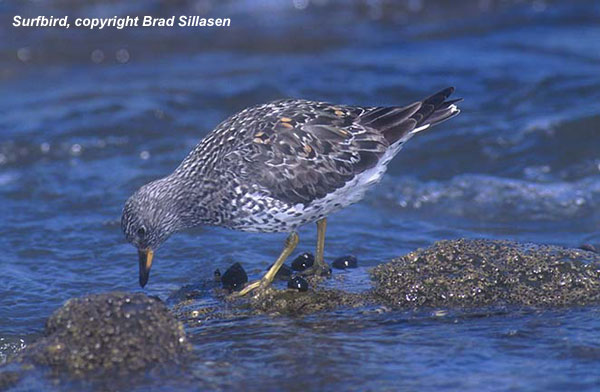
The next morning, I headed down to Laguna Beach to look for Gulls and Shorebirds. I was not disappointed. After eating a tasty breakfast burrito as a local beach shack, I headed down Marine Drive to the coastal access point. The first birds sighted were a mixed flock of Western and Heermann’s Gulls. I followed the gulls down to a rocky outcropping where a number of shorebirds were feeding, including Surfbirds, and both Ruddy and Black Turnstones. I made my way about a mile down the beach before retuning to Cliff Drive. A number of birds were observed along the way.


Surfbird
Image Credit: Brad Sillasen

Here are my observations:
Brown Pelican 15
Brandt's Cormorant 5
Double-crested Cormorant 4
Pelagic Cormorant 7
Spotted Sandpiper 1
Willet 1
Ruddy Turnstone 1
Black Turnstone 11
Surfbird 14
Heermann's Gull 18
Western Gull 25
Herring Gull 1
Anna's Hummingbird 1
Brewer's Blackbird 4


Hollywood Hills

I spent most of the next day attending to business in LA, after which I fought through the lovely LA traffic toward Griffith Park. The park sits just east of the Hollywood Hills and provides a nice view of the famous Hollywood sign. You can drive up to the top, but its hard to see birds that way. Alternatively, you can make the short 20 minute hike to the top and view birds along the way. I choose the latter, taking in many birds, including a sizable flock of Bushtits, lots of Acorn Woodpeckers, and a Northern “Red-shafted” Flicker.


Red-shafted Flicker
Image Credit: IBC

Here are my observations:
Acorn Woodpecker 9
Northern Flicker (Red-shafted) 1
Black Phoebe 2
Common Raven 1
Bushtit 19
American Robin 1
Northern Mockingbird 1
Yellow-rumped Warbler 20
California Towhee 1
White-crowned Sparrow 1
House Finch 2
Lesser Goldfinch 3


Ventura County

This was the day for the BIG TRIP out to the Channel Islands, specifically to Santa Cruz Island, to see the Island Scrub Jay. As luck would have it, the trip didn’t pan out. The Santa Ana winds were blowing that day making for choppy seas. The trip was cancelled.

Rather than let the day go to waste, I decided to do some birding on the Ventura Coast and in Big Sycamore Canyon. I made two stops along the Ventura Coast, first at the Ventura Pier, and then at Emma Woods State Beach. Of the two, Emma Woods Beach was the more productive, especially along the Ventura River Trail where I spotted a large flock of White-crowned Sparrows, an Eared Grebe and a pair of Bewick’s Wrens.


Heermann’s Gull
Image Credit: Richard Wong

Here are my observations:
Mallard 8
Ruddy Duck 3
Pied-billed Grebe 4
Western Grebe 5
Eared Grebe 1
Brown Pelican 18
Great Blue Heron 1
Snowy Egret 2
Black-bellied Plover 1
Willet 60
Marbled Godwit 23
Sanderling 11
Heermann's Gull 30
Western Gull 50
Osprey 1
American Kestrel 1
American Coot 20
Bushtit 3
Bewick's Wren 2
Blue-gray Gnatcatcher 2
Black Phoebe 1
California Towhee 2
Vesper Sparrow 1
Savannah Sparrow 1
White-crowned Sparrow 40
House Finch 1


In the afternoon, I headed down to Big Sycamore Canyon in Point Magu State Park. As the name suggests, there were quite a few sycamores in the park. Among other birds, these trees served as home to a sizable population of Black-hooded Parakeets. The park is also home to a number of chaparral and riparian species. I observed several of these in the park, including California Thrasher, Wrentit, and Nuttall’s Woodpecker. There is also beach access just across Highway 1 where a variety of birds can be seen.


Nuttall’s Woodpecker
Image Credit: San Jose Parks

Here are my observations:

Western Grebe 3
Brown Pelican 9
Double-crested Cormorant 2
Pelagic Cormorant 2
Sanderling 12
Heermann's Gull 8
Caspian Tern 2
Black-hooded Parakeet 8
Nuttall's Woodpecker 3
Northern Flicker 1
Black Phoebe 1
Western Scrub-Jay 1
Common Raven 1
Wrentit 5
California Thrasher 1
Yellow-rumped Warbler 20
California Towhee 2
Savannah Sparrow 2
White-crowned Sparrow 2


Santa Monica Mountains - Malibu

The following morning, I headed back to LA. On the way back, I made two stops. One at Malibu Creek State Park and the second at Malibu Lagoon.

Malibu Creek Park is composed of 7,000 acres of rugged country in the middle of the Santa Monica Mountains. I hiked along the main path paralleling the creek. My destination was the old M*A*S*H site; however, due to all the birds observed during the hike, I never made it. In fact, I didn’t go much beyond the visitor’s center. Among the many birds observed in the park were Say’s Phoebe, Cassin’s Kingbird and Oregon Juncos.


Oregon Junco
Image Credit: Michael Franz

Here are my observations:

Cooper's Hawk 1
Red-tailed Hawk 2
American Kestrel 1
Merlin 2
Acorn Woodpecker 9
Hairy Woodpecker 1
Northern Flicker (Red-shafted) 1
Black Phoebe 2
Say's Phoebe 2
Cassin's Kingbird 2
Western Scrub-Jay 8
American Crow 3
Common Raven 1
Oak Titmouse 19
Bushtit 3
White-breasted Nuthatch 1
Ruby-crowned Kinglet 3
Western Bluebird 8
California Towhee 1
Song Sparrow 2
Dark-eyed Junco (Oregon) 4


Malibu Lagoon was next on the agenda. I hit the beach late in the afternoon. It was a bit breezy and there were not many people on the beach. Up near the lagoon, a number of gulls and pelicans were resting on the beach. Among the Heermann’s, Herring and Western Gulls were several California Gulls – lifers for me. My daughter made friends with a fairly tame Greater White-fronted Goose, to whom she fed some bread. Also, to my surprise, my wife spotted three Snowy Plovers. The lagoon itself was teeming with waterfowl, cormorants and waders. Notable among them were several Clark’s Grebes, a Solitary Sandpiper and a large flock of Marbled Godwits.


Snowy Plover
Image Credit: Birds & Blooms

Here are my observations:

Greater White-fronted Goose 1
Gadwall 4
Mallard 20
Northern Shoveler 12
Ruddy Duck 20
Pied-billed Grebe 6
Clark's Grebe 2
Brown Pelican 40
Double-crested Cormorant 20
Great Blue Heron 2
Great Egret 6
Snowy Egret 9
American Coot 200
Black-bellied Plover 1
Snowy Plover 3
Killdeer 1
Solitary Sandpiper 1
Marbled Godwit 60
Heermann's Gull 8
Western Gull 70
California Gull 4
Herring Gull 5


Joshua Tree National Park

Having birded the coastal areas, I decided to head inland to Joshua Tree to look for desert species. I entered the park via the north entrance, near 29 Palms. I hit most of the scenic spots indicated on the park map. Overall, the birds were pretty sparse, as one might expect. That being said, there were some excellent birds to be seen, many of which were lifers for me. The first stop was at Jumbo Rocks where I saw a lone Phainopepla. The following few stops yielded few birds. I then hiked out to Barker Dam, only to find evidence of California’s drought – no water and no birds. On the hiking trail, I spotted a small flock of Black-throated Sparrows, and my wife pointed out a Verdin. We then visted most of the other scenic spots in the park but saw nothing other than a few Ravens and some Red-tailed Hawks. Our final stop was Cottonwood Springs, which we hit about an hour before sunset. It was teeming with birds, including a large covey of Gambel’s Quail, and small flocks of Black-throated Sparrows and Lesser Goldfinch, and a nice mix of other passerines.


Gambel’s Quail
Image Credit: Richard Seaman

Here are my observations:

Gambel's Quail 20
Red-tailed Hawk 4
American Kestrel 1
Loggerhead Shrike 1
Common Raven 5
Verdin 1
Cactus Wren 4
Northern Mockingbird 1
American Pipit 1
Phainopepla 1
Yellow-rumped Warbler 2
Black-throated Sparrow 7
White-crowned Sparrow 2
Dark-eyed Junco (Oregon) 2
Western Meadowlark 1
House Finch 2
Lesser Goldfinch 8


Huntington Library Botanical Garden

The last leg of the trip, before returning to LAX, was a stop at the Huntington Botanical Gardens near Pasadena. According to the Huntington Library website, the gardens “covers 207 acres, of which approximately 120 are landscaped and open to visitors. More than 14,000 different varieties of plants are showcased in more than a dozen principal garden areas.”. As you can imagine, the gardens draws a nice variety of birds, including many hummingbirds. During my visit, I found the desert garden to be the most productive for birding. Among the many birds seen there were two exotics - Red-whiskered Bulbul and Yellow-chevroned Parakeet.


Red-whiskered Bulbul
Image Credit: Avian Resources

Here are my observations:

Mallard 4
Red-tailed Hawk 2
Rock Pigeon 8
Band-tailed Pigeon 3
Yellow-chevroned Parakeet 2
Anna's Hummingbird 5
Allen's Hummingbird 2
Acorn Woodpecker 2
Northern Flicker (Red-shafted) 1
Black Phoebe 3
Western Scrub-Jay 2
American Crow 11
Bushtit 40
Cactus Wren 1
House Wren 1
Red-whiskered Bulbul 14
Ruby-crowned Kinglet 3
Northern Mockingbird 3
European Starling 5
Cedar Waxwing 20
Yellow-rumped Warbler 8
Wilson's Warbler 1
Spotted Towhee 3
California Towhee 4
Fox Sparrow (Sooty) 1

Summary

Before I knew it, it was time to head home. But the birding was not done. On the way to LAX, I observed several White-throated Swifts circling above on the exit ramps on 405. That bought my total for the trip to 104 species, 36 of which were lifers for me. In addition, I observed several sub-species that were also lifers – the Sooty Fox Sparrow, the Oregon Junco and the Red-shafted Flicker. Incidentally, I surpassed the 300 species mark for the US on the trip, with Nutall's Woodpecker being 300. In total, I have 317 US species (472 World). Although there were many exciting birds, the highlights of the trip were the Verdin and the Black-throated Sparrows. I found that the Sibley Guide, as well as every other other guide I checked, does not do the Black-throated Sparrow justice. It was one of the most spectacularly handsome birds I have seen anywhere in the world.

Sunday, March 22, 2009

Little Stint - #400 on Life List


Little Stint, Calidris minuta
Image Source: Wikipedia

I was going over my life list this weekend in an effort to try and organize all my birding data. Although I have been birding since 1983, I didn't start keeping records until 2001. On record, I have observed 407 species of birds. Of these 249 have been observed in the U.S., 115 in Asia (Taiwan & Hong Kong), and 43 in the Arabian Peninsula (UAE & Oman).

On my recent trip to the Middle East, I passed the 400 species mark. Being that there are approximately 10,000 species of birds, it would seem that I still have a ways to go to catch-up with Phoebe Snetsinger.

The Little Stint was #400. I observed it at the Ras Al Khor Wildbird Sancturary in Dubai. There were several hundred individuals present, along with an assortment of other waders.

I referenced Wikipedia to get a little background on the bird. Here is an excerpt:

The Little Stint, Calidris minuta, is a very small wader. It breeds in arctic Europe and Asia, and is a long-distance migrant, wintering south to Africa and south Asia. It occasionally is a vagrant to North America and to Australia. It is gregarious in winter, sometimes forming large flocks with other Calidris waders, particularly Dunlin, on coastal mudflats or the edges of inland pools.

Its small size, fine dark bill, dark legs and quicker movements distinguish this species from all waders except the other dark-legged stints. It can be distinguished from these in all plumages by its combination of a fine bill tip, unwebbed toes and long primary projection. The call is a sharp "stit",

The breeding adult has an orange wash to the breast, a white throat and a strong white "v" on its back. In winter plumage identification is difficult. Juveniles have pale crown stripes and a pinkish breast.

This bird nests on a bare ground scrape laying 3-5 eggs. It is polygamous, and male and female may incubate separate clutches.

Food is small invertebrates picked off the mud.

Tuesday, March 17, 2009

Birding in the UAE and Oman


Greater Flamingo
Photo Credit: Arkive

It’s not quite spring! Nevertheless, Spring Break was on the calendar, so we packed up the family and headed east – to the Middle East actually - to visit friends. As always, I brought my bird book and binoculars. I never go anywhere without them.

We spent spring break in Dubai, one of the seven emirates of the United Arab Emirates (UAE). I used two guides for the trip, Birds of the Middle East by Porter et al., and Birds of the United Arab Emirates by Richardson.


Birds of the Middle East

The Porter guide is the best guide for the region. I was quite happy with it, however, it could use a few improvements. Most noteably of which are the range maps which show only the know breeding areas. Overwintering area and migration regions are not show. Also,a few of the paintings could be improved, such as the Purple Sunbird and the Laughing Dove.


Birds of the United Arab Emirates

The Richardson guide is a must-have. Although it has line drawings of most and photos of many of the regions birds, I would defer to Porter for IDs. The strengths of the Richardson guide are its limitation to UAE birds, its info on migrations and seasonal abundance, and its descriptions of the key birding sites in the region.

I would also like to thank Steven Feldstein and Tommy Pedersen for help in sorting out some of my observations.

Mizrah
We arrived in town – the Mizrah district - late Friday night. I could hardly sleep, anticipating what yards birds would make their appearance in the morning. Just before 6 am, I heard the first bird song. It sounded very familiar. I suspected that it was a House Sparrow. Not wanting my first Middle Eastern bird to be a House Sparrow, I refused to verify it by sight. I decided to hold out for something else. I didn’t have to wait very long. I was rescued by a White-cheeked Bulbul.


White-cheeked Bulbul, Pycnonotus leucotis
Photo Credit: Wikipedia

The House Sparrow was second. In retrospect, I believe I owe the House Sparrow an apology. The House Sparrows in Dubai were quite interesting in their own right. Relative to the one’s back here in the US, they are somewhat paler in appearance. In addition, they frequently build their nests in trees, like birds are supposed to do, rather than in the space below one’s air conditioner or in a crack in the siding.

Over the course of the next two hours, a few more birds showed up, the highlights being the Eurasian Hoopoe and the Crested Lark. These birds were nesting nearby and made regular appearances in the yard. The Hoopoe would typically show up fairly late in the morning, usually alone but sometimes in a pair. They methodically probed the lawn for insects/invertebrates in a manner more becoming a dowitcher or other long-billed sandpiper. I tracked down their nest to a small hole in the base of a neighbors garden wall.

The Crested Larks were relatively abundant in the neighborhood. Although they were observed in the morning, they were much more common in the early afternoon just after the lawn sprinklers shut off. They were also frequent visitors in vacant lots around clumps of vegetation. They mainly procured their food by hopping around the ground, pecking at the dirt or gleaning insects. Occasionally, they would begin singing and fluttering about 20-30 ft. above the ground, struggling to hover. I observed one singing from his hover-spot at over 100 ft. It was quite impressive!

Here are my observations for yard birds for the week:
White-cheeked Bulbul
House Sparrow
Eurasian Hoopoe
Crested Lark
Rock Pigeon
Collared Dove
Common Mynah
Ring-necked Parakeet
Common Swift
Laughing Dove
Graceful Prinia
Red-vented Bulbul
Purple Sunbird


Sharjah


Indian Roller, Coracias benghalensis
Photo Credit: Wikipedia

Later that morning, we headed to the neighboring emirate of Sharjah to pick-up the kids at the Girl Scout camp. Although we didn’t stay long, I did observe several interesting birds: Laughing Dove, Long-legged Buzzard, and Indian Roller.

We then took a ride through the sand dunes in the desert. It’s a bit of a local sport in the Emirates. During the course of the trip, we made several stops the observe wandering packs of camels and take in some of the birds. It was the hottest part of the day, so there were not as many birds as I would have liked. Nevertheless, I made a few interesting observations.

Sharjah Observations:
Laughing Dove
Long-legged Buzzard
Indian Roller
Southern Gray Shrike
Red-wattled Lapwing
Chestnut-bellied Sandgrouse
European Bee-eater
Little Green Bee-eater


Old Town & Dubai Creek


House Crow, Corvus splendens

Sunday, we headed downtown to visit the old souks (markets) along the Dubai Creek. We had to take a small abra across the creek. It is only about a 10 minute ride, but there were plenty of birds – mostly Black-headed Gulls – to keep one busy. There were also a few gulls of the Black-backed Gull complex, most likely Steppe Gulls, and one Socotra Cormorant on the creek. Once on the other side, we toured the souks and then visited the Al Fahidi Fort (now a cultural museum) near the Persian Mosque. The wall of the fort afforded numerous nesting places for swifts, who seemingly took advantage of every one. There were thousands of Pallid Swifts circling the sky above the fort. In many cases, you could literally reach out and grab one, as they came within arm’s length. Outside the fort and along the banks of the creek, House Crows were plentiful.

Dubai Creek Observations:
Steppe Gull
Yellow-legged Gull
Socotra Cormorant
Pallid Swift
Red-vented Bulbul
House Crow
Ring-necked Parakeet


Safa Park


Purple Sunbird, Nectarinia asiatica

Safa Park is an urban park located along Sheikh Zayed Road, near the downtown business district. It is a manicured garden-style park with mowed lawn, trimmed hedges, and artificial water features. That being said, it had a surprising diversity of birds.

The first bird of the day was an old-world warbler that I could not ID. I got a few brief looks at it, but still could not key it out. It was grayish-brown on the back, and white on the throat, breast, and vent. It was otherwise unmarked. The only “marks” that I could distinguish were a dark narrow pointed bill with a touch of yellow on the lower mandible. It also had a white or buffy supercilium and somewhat darker primaries. It was feeding in the understory of a broadleaf tree. In combing through the field guide and consulting with a experienced birder in the region, my best guess is that it was a Lesser Whitethroat. But it’s just a guess.

I spent about 2.5 hours in the park, until it got too hot for the kids. In all, I observed about 25 species, the highlights being the Purple Sunbird, Pied Mynah, Indian Silverbill, and Egyptian Goose. The Purple Sunbird was the most spectacular bird in the park. The apparently evolved to fill the same niche as hummingbirds by convergent evolution. At a distance or in low light, the Purple Sunbird appears black. However, in full sun, it takes on a metallic steel blue or purple irridesence. Unlike the hummer, it has a melodious song. I observed one singing from a well-lit perch. While singing, it displayed scarlet and yellow pectoral tufts. I found no mention of these in the Porter field guide.


Pied Mynah, Sturnus contra
Image Credit: Wikipedia

The Egyptian Goose was observed in the fenced in bird sanctuary at the back of the park. The goose is a tropical African species that occasionally winters in Cyprus. Its presence in the Arabian peninsula is most likely due to its introduction or escape from exotic collections. It has since established breeding colonies in the region. Pied Mynahs are also apparently introduced.

Safa Park Observations:
Lesser Whitethroat (putative)
Laughing Dove
Red-vented Bulbul
White-cheeked Bulbul
Black-headed Gull
Indian Roller
Pied Mynah
Common Mynah
House Sparrow
Indian Silverbill
Graceful Prinia
Sparrowhawk
Grey Heron
Mallard
Red-wattled Lapwing
Common Sandpiper
Ring-necked Parakeet
Egyptian Goose
White Wagtail
Gray Wagtail
Eurasian Hoopoe
Little Grebe
European Roller
Purple Sunbird
House Crow
Gray Francolin


Mushrif Park


Little Green Bee-eater, Merops orientalis
Photo Credit: Wikipedia

Mushrif Park is a natural woodland park located in the Mizhar area, about 10 miles from the Dubai Airport. The park has one main road going straight through the middle and connecting to another road which encircles the park’s perimeter. Many birds can be seen from the car. Getting out and walking around can also flush out a few surprises. I spent about 2 hours in the park. The highlights were the Menetries Warbler, Great Spotted Eagle, Southern Gray Shrike and the Little Green Bee-eater. The Bee-eaters were first spotted on a fence near the maintenace area. Two bee-eaters were perched on the end of an acacia tree, in a manner reminiscent of a shrike or kingfisher. Upon spotting its prey, it would sally forth and snatch it out of the air or glean it off a leaf. Their skillful gathering of food was quite a spectacle to watch.

Mushrif Park Observations:
Laughing Dove
Southern Grey Shrike
Ring-necked Parakeet
Eurasian Hoopoe
House Sparrow
Collared Dove
Red-vented Bulbul
Rock Pigeon
White-cheeked Bulbul
Gray Francolin
Purple Sunbird
Great Spotted Eagle
Menetries Warbler
Graceful Prinia
House Crow


Ras Al Khor Waterbird Sanctuary

Ras Al Khor Sanctuary is essentially a lagoon at the end of a Dubai Creek. The area is completely fenced off and has guards 24/7. The only access one has to the park is a series of bird blinds – which are quite good. The blinds also have stationed guards.

The number of shorebirds the area draws is quite impressive. I think they must feed the birds or something. I know for a fact that they feed the Flamingos, as the guard showed me the food pellets. Anyway, we stayed for a little more than an hour and got a good look at a number of interesting birds – the highlight being the Greater Flamingos. In all, there were about 5000 flamingo according to the guard. From what I saw, it seemed there were less, but then again we only had a view of part of the lagoon.

In addition to the Flamingo, we also saw a nice variety of other waders and other birds, the highlights being: Cormorant, Common Snipe, Western Reef Heron, Terek Sandpiper, Eurasian Curlew, Temminck’s Stint, Little Stint, Redshank, Greenshank & Greater Spotted Eagle.


Greater Spotted Eagle, Aquila clanga
Photo Credit: Arkive.org

Ras Al Khor Observations:
Greater Flamingo
Greenshank
Black-winged Stilt
Cormorant
Common Snipe
Western Reef Heron
Kentish Plover
Terek Sandpiper
Ringed Plover
Greater Spotted Eagle
Little Egret
Great Egret
Little Stint
Eurasian Curlew
Redshank
Temminck's Stint
Common Sandpiper


Musandam, Oman


Hume’s Wheatear, Oenanthe albonigra
Photo Credit: Ardeola's photostream

On Friday, we went over the border into the northern part Oman, to Musandam. We stayed at the Golden Tulip Hotel, overlooking the Gulf of Oman. There are a number of small islands overlooking the Strait of Hormuz. We hired a dhow to take us out looking for dolphins and such. We saw a number of spectacular birds both on the mainland and out on the islands. The highlights were the Isabelline Shrike, Hume’s Wheatear, Yellow-vented Bulbul, Clamorous Reed Warbler, African Rock Martin and Great Black-headed Gull.

The Great Black-headed Gull was spotted from our hotel balcony. All morning we had large flocks of Black-headed Gulls, but I was careful to scan each one for tag alongs. The Great Black-headed Gull caught my eye because of its size and large yellow bill. I was really excited to see it. There were also a few Socotra Cormorants as well. Outside our hotel there were lots of rocky cliffs attended by feral and domesticated goats. There were also a few birds in the mix. The Isabelline Shrike was perched atop an acacia tree and hunting insects and lizards. I observed it snatch-up at least one small lizard or geckoe.


Great Black-headed Gull, Larus ichthyaetus
Photo Credit: Juhani Kyyrö, Virtual Bird

Oman Observations:

House Sparrow
Laughing Dove
Purple Sunbird
Isabelline Shrike
Socotra Cormorant
Black-headed Gull
Great Black-headed Gull
African Rock Martin
Hume’s Wheatear
Yellow-vented Bulbul
Caspian Tern
Clamorous Reed Warbler


Overall, I observed 61 species, 43 of which were lifers for me. As always, there were a few disappointments. I has several birds on my target list that I did not get the opportunity to see, such as the Masked Shrike, Little Owl and Arabian Babbler, but I can not complain.